


















Chapter 71

Gardener
AI Summary
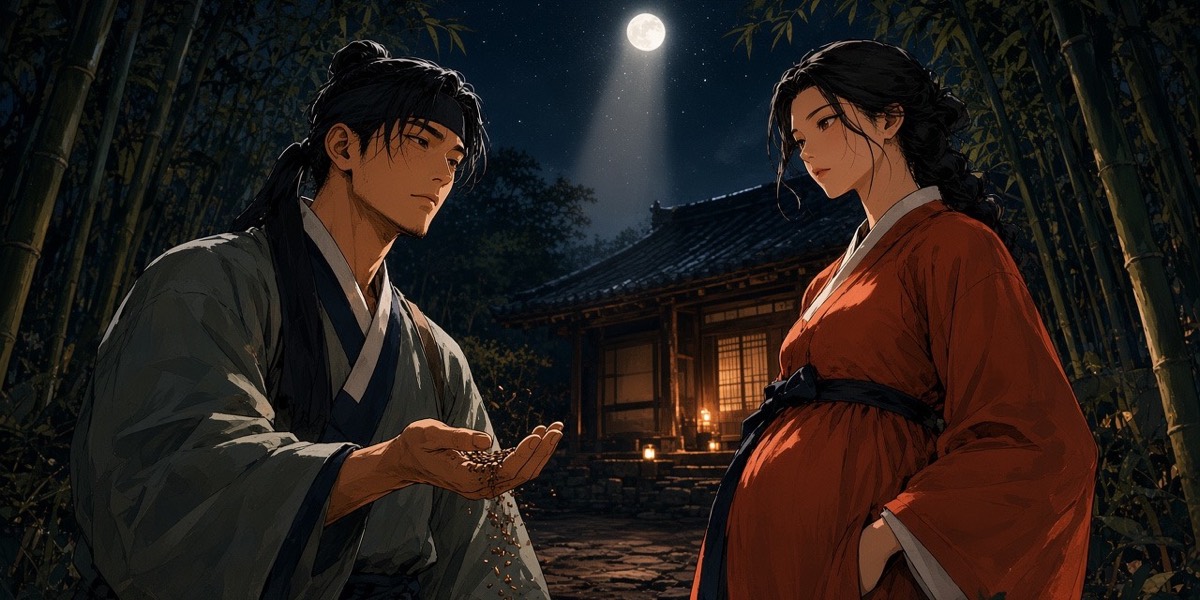
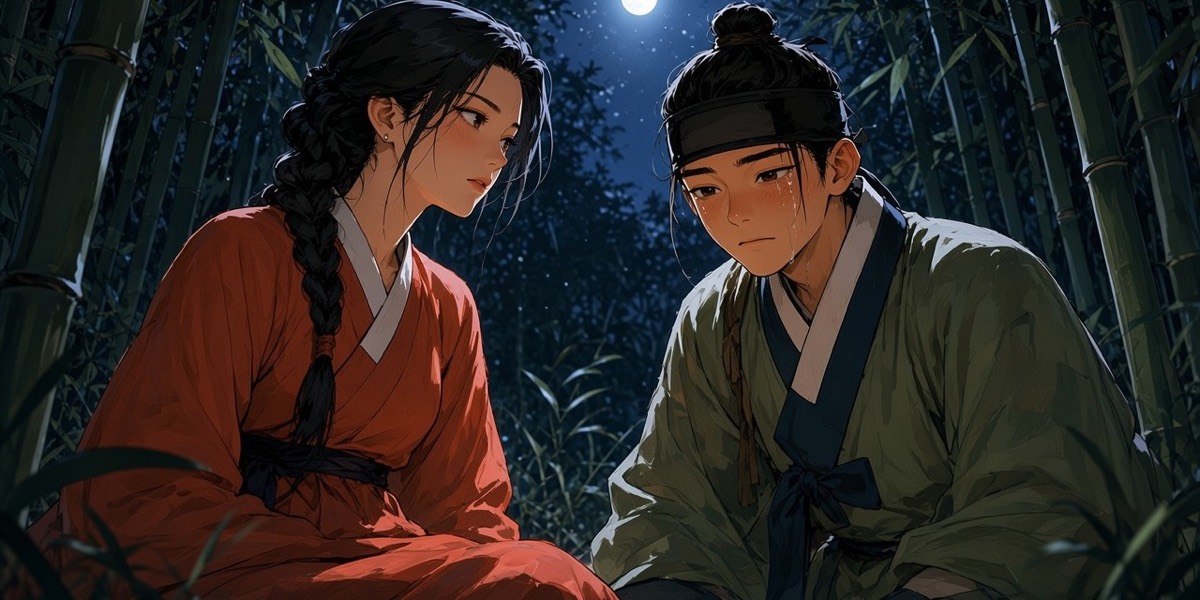
- Sara’s Yard They had a house at the edge of the bamboo.
- The Western Field Sara walks west until the living maps quit.
- The Magistrate’s House Wonganghami walks to the thousand-year gate with nothing but the child and half a comb’s absence in her hair.
- The Back Spring The backyard has a spring the roof paid for.
- The Hall Some nights he sits in the main hall and watches the dancing girls.
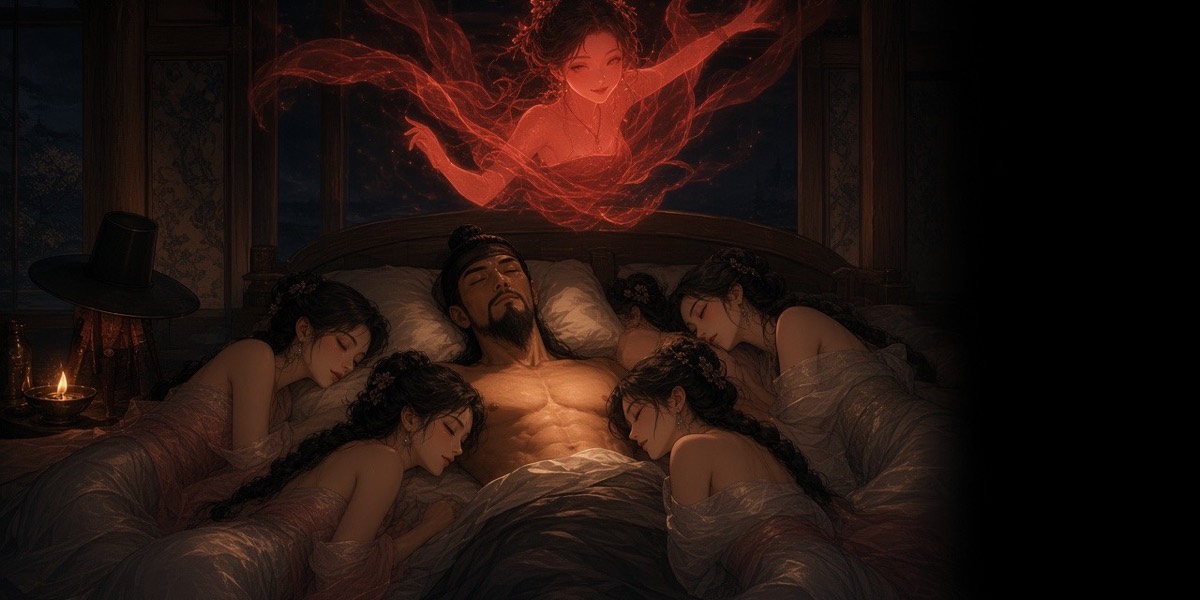
- His Bed Some nights the bed is full.
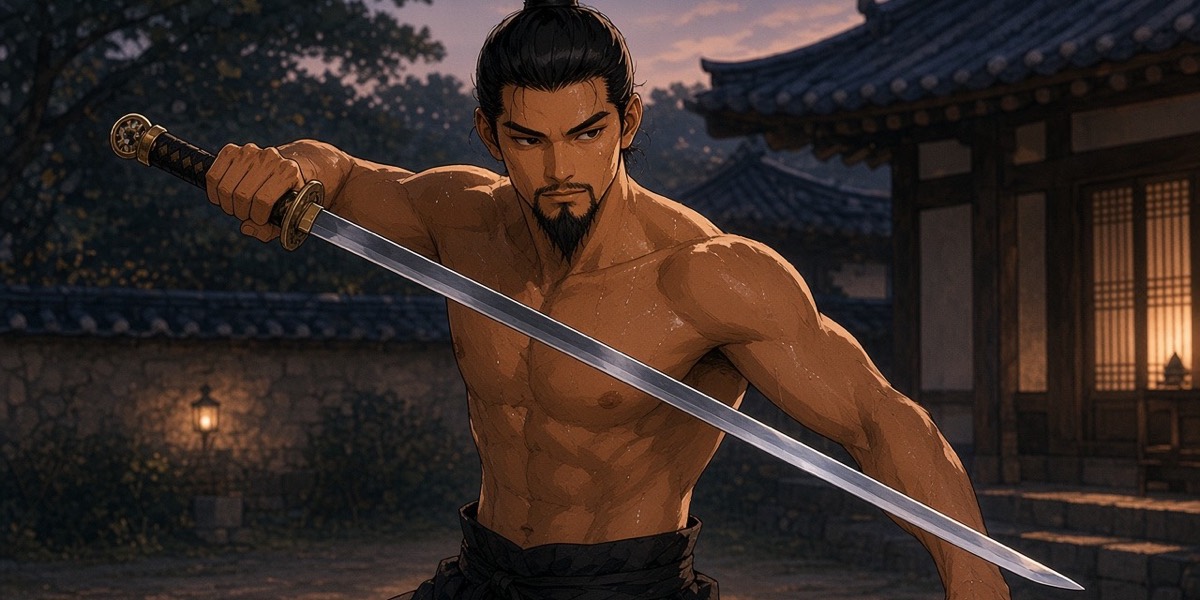
- The Yard By day he trains in the backyard with a ring-pommel sword.
- The West Road The bloodhounds are older than the roof, as promised.
- The Servant Room He finds her in the servant room.
- The Twelve Passes The west road climbs before it learns how to drown.
- The Three Rivers The first water comes to his knees.
- The Flower Field The living maps run out.
- Characters
Episode· 655
Gardener
The world did not know how to make a soul. The Sky Princess finds the Life Flower. Heaven–Earth King names her 삼신, and the sea’s daughter 구삼신.
- Wonganghami
- Hallakgungi
- The Magistrate
- Sara
- The Third Daughter
- Gyebek
- The First Daughter
- The Second Daughter
- Yuri Dora
9 stills without a cue
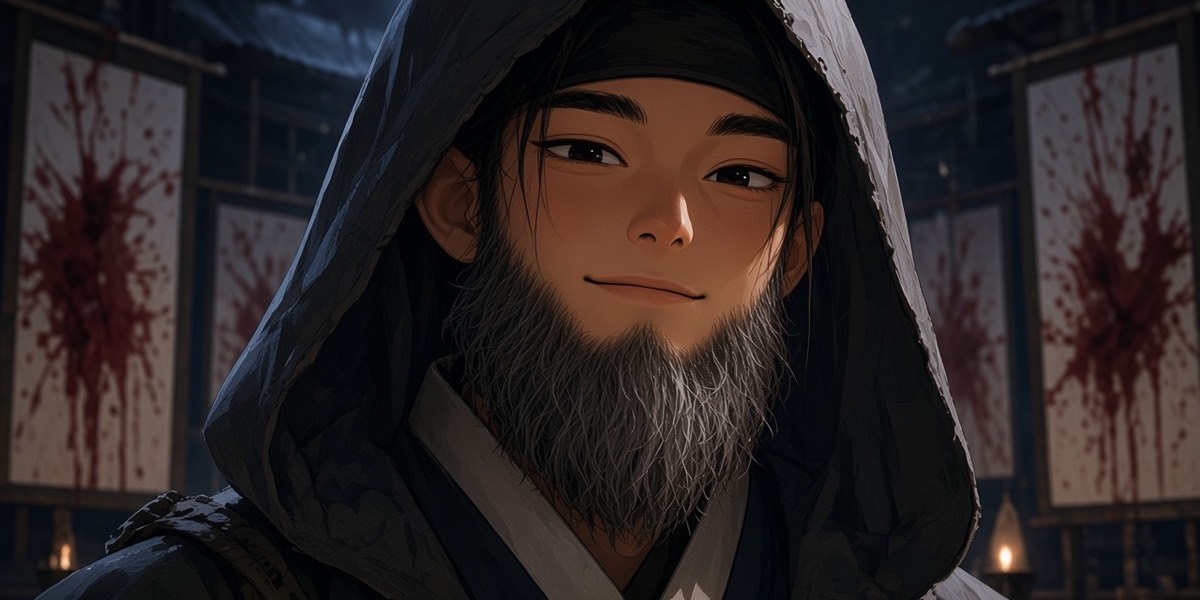
You know the smile. The young gardener’s. This is the night it started costing.
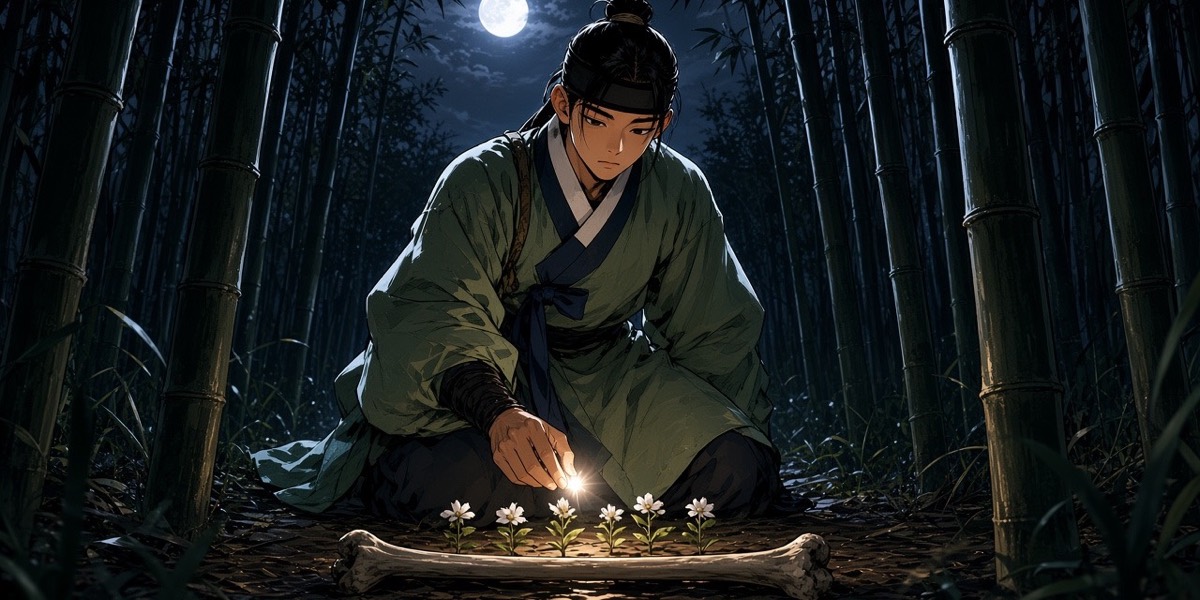
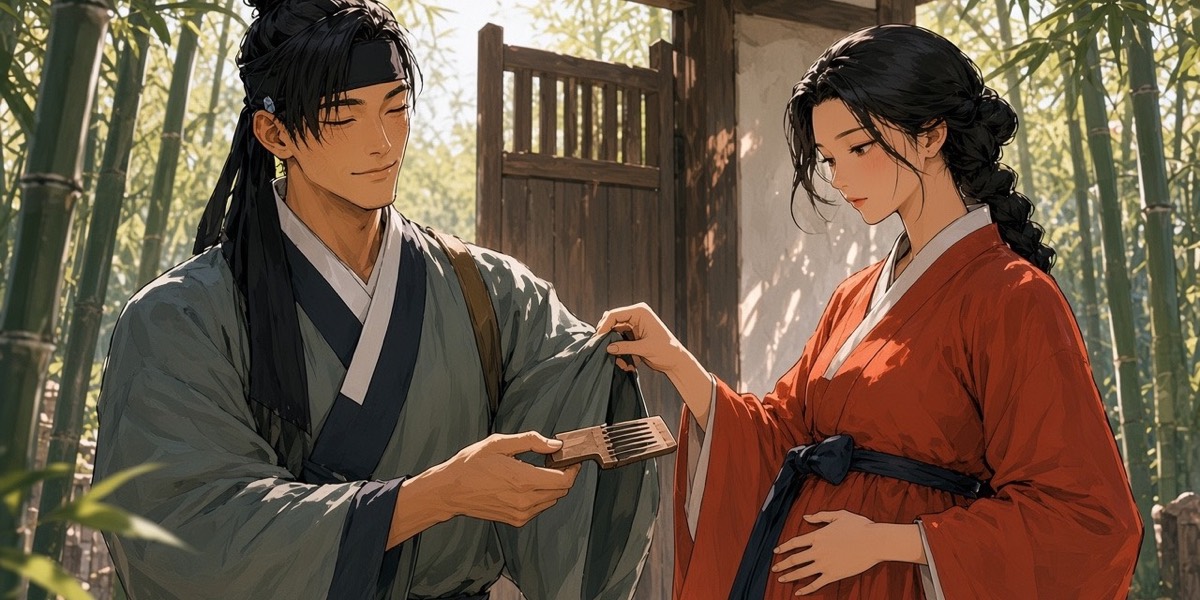
They had a house at the edge of the bamboo. She was carrying. He was counting seeds. That is what he does when he does not want to think.
Then something older than the two suns spoke from above the roof. It does not give a name. It never does.

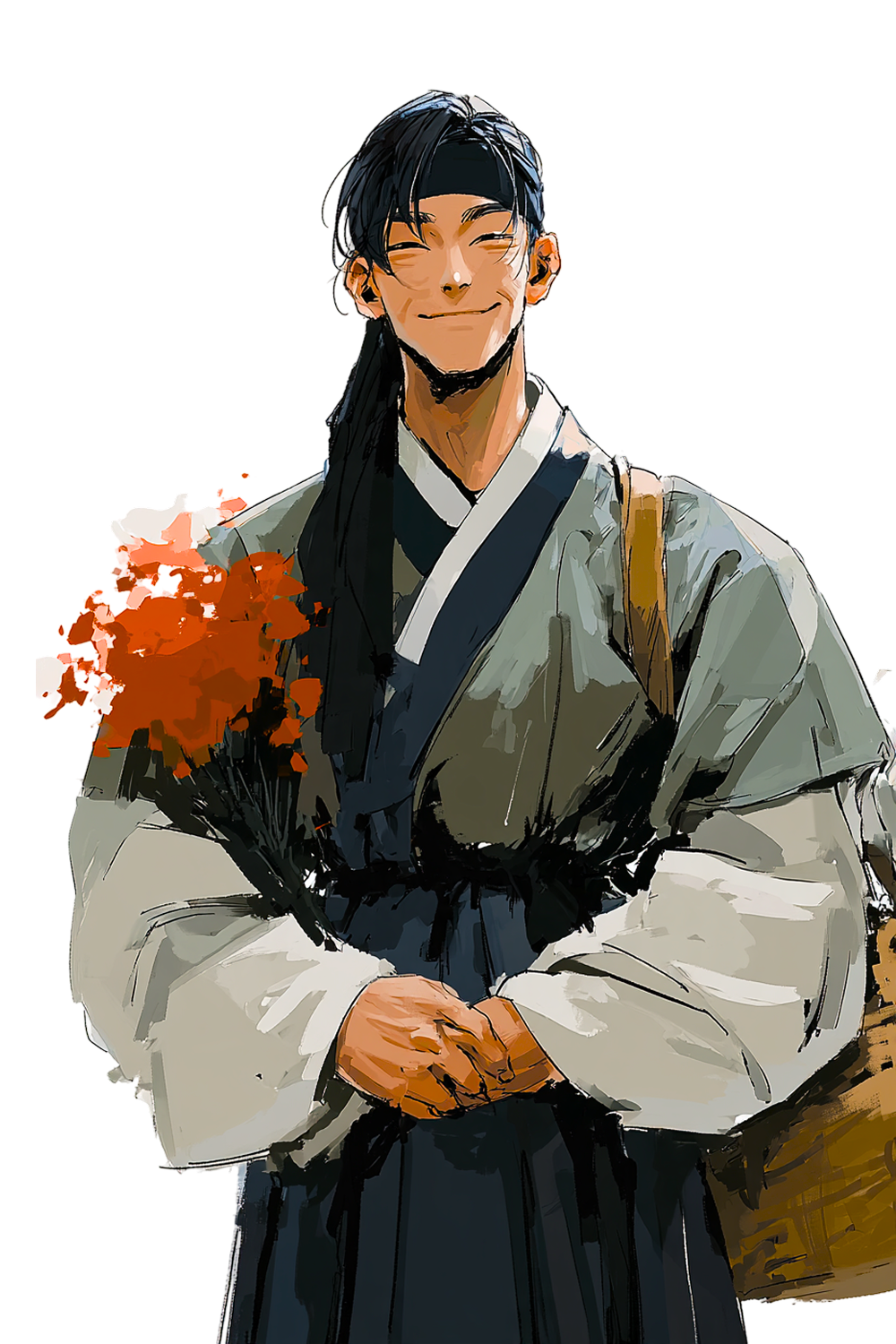
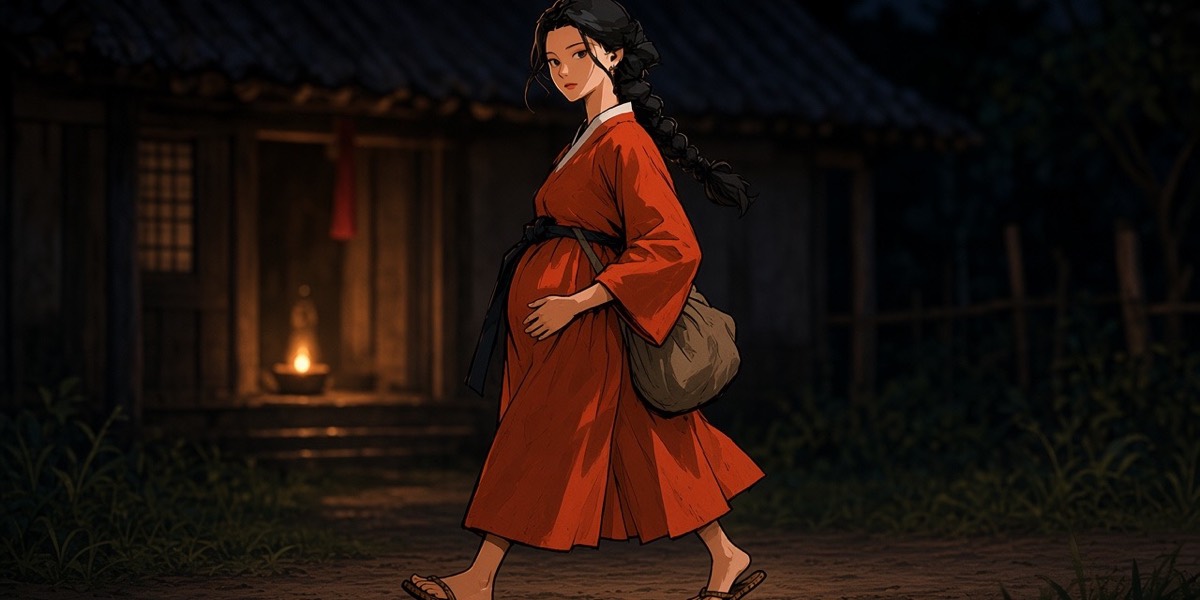
He looks at her. She already has her sandals on.
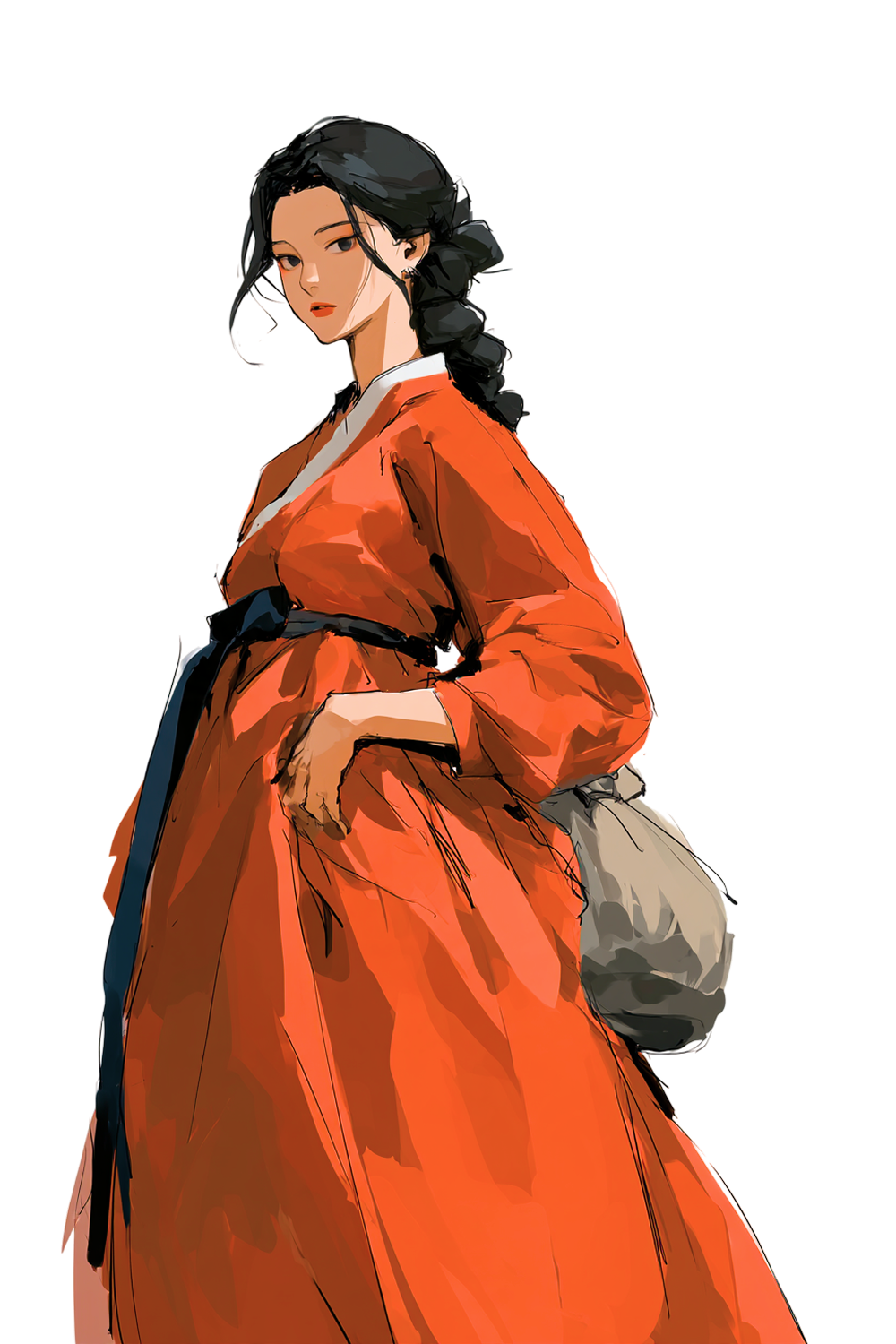
He hates that sentence. He does it anyway. At the gate she snaps her comb in half and puts one piece in his sleeve.
He does not say how long. did not tell him.
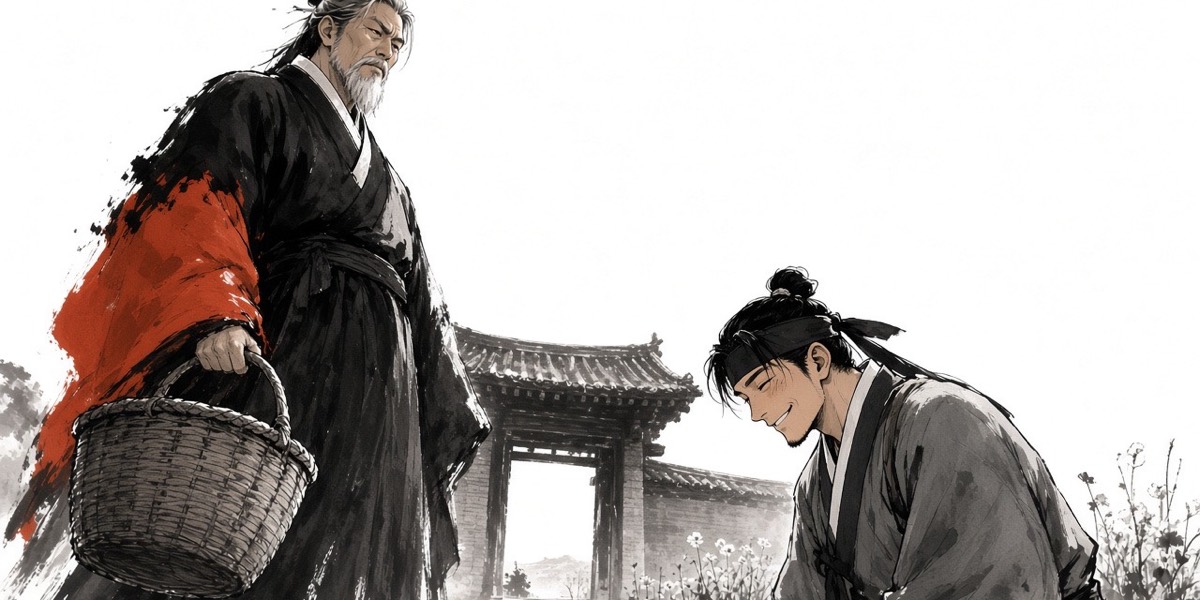
walks west until the living maps quit. The rows are already there, waiting on nobody. At the gate, light. Not a lamp. Not a moon. A man-shaped brightness with no face inside it — or a face you are not allowed to keep.
This is the only time in this story that light will stand that close. Remember it. You will not see it again.
bows to a brightness. He never sees the mouth that hired him. He puts the basket on his hip and starts counting, because that is what he does when he does not want to think about the house he left.
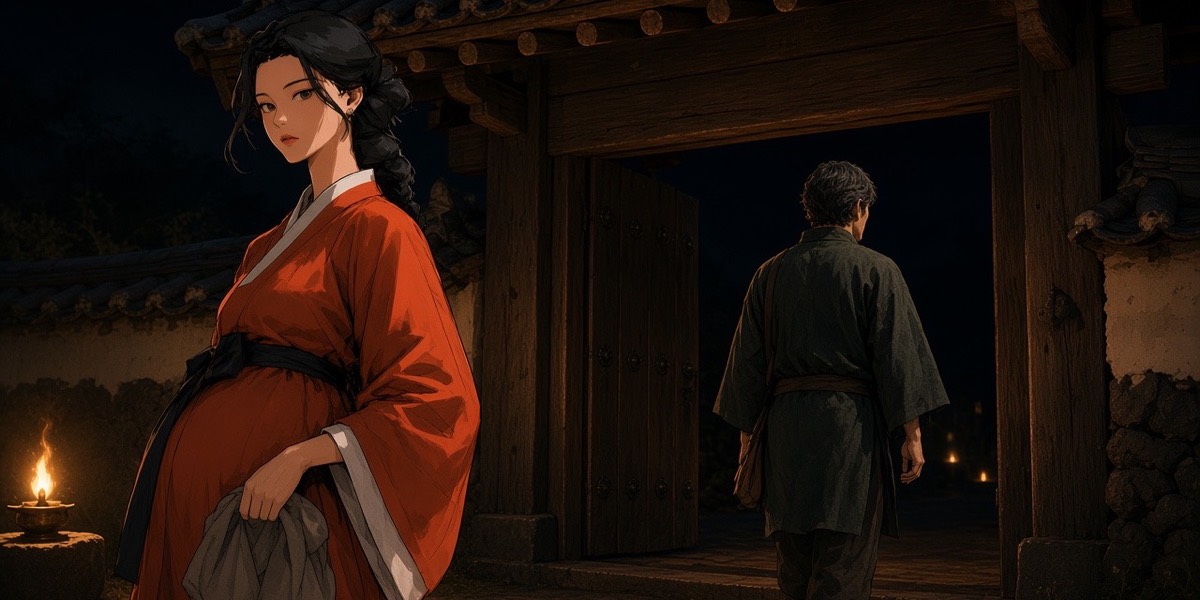
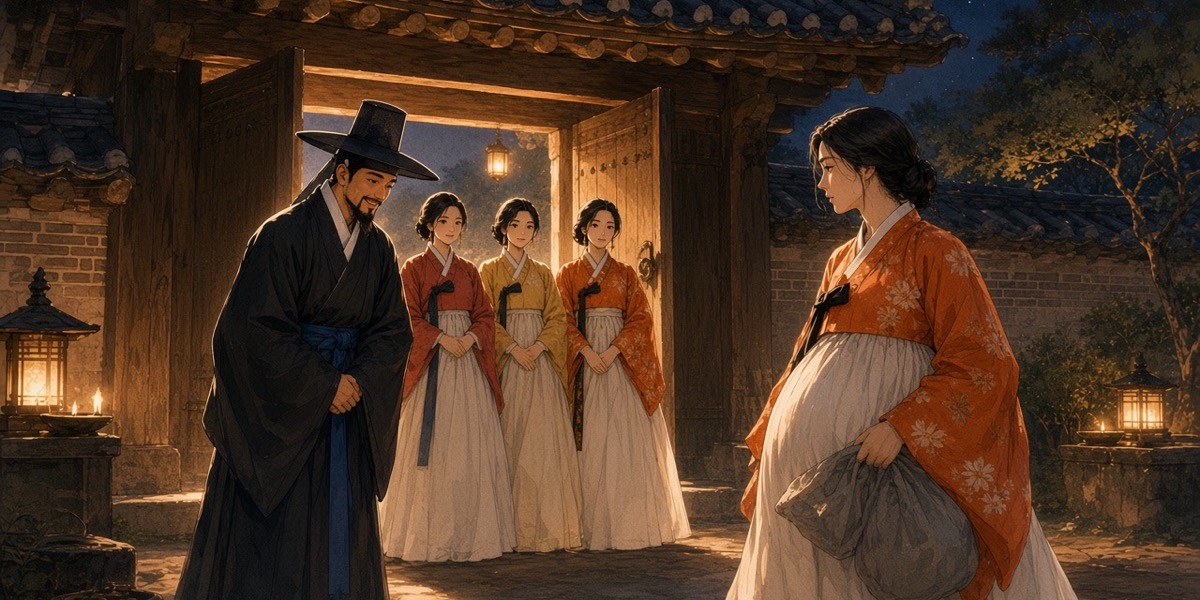
walks to the thousand-year gate with nothing but the child and half a comb’s absence in her hair. The man who opens it looks kind. Soft voice. Soft hands. The kind of soft that has never had to ask twice.
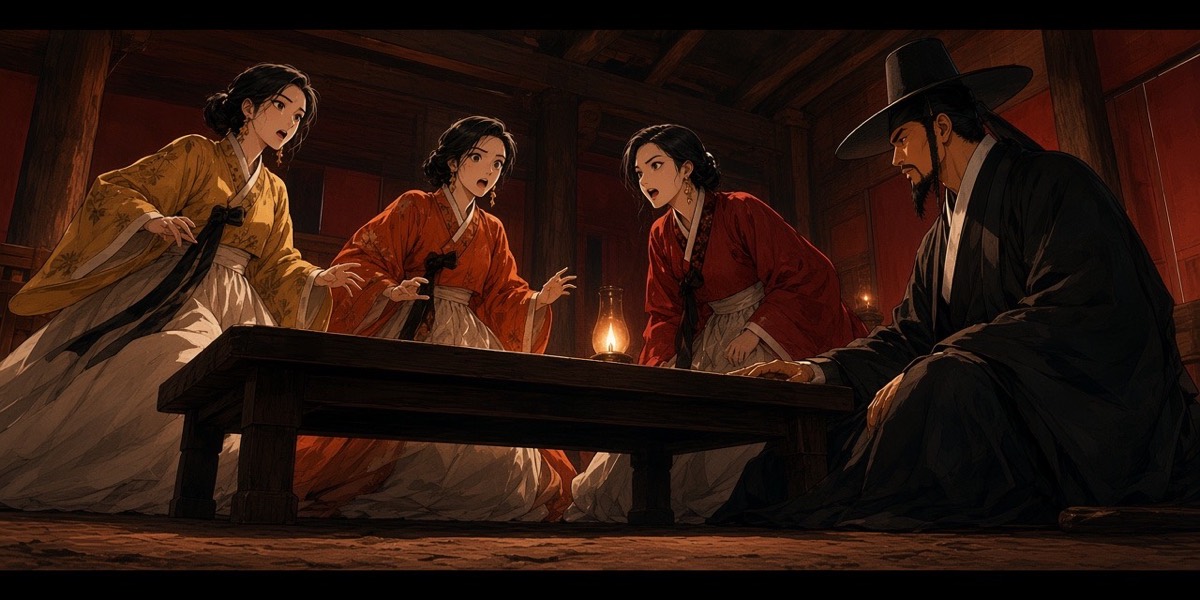
His three daughters stand behind him in clean silk, smiling the way a house smiles when it has room. He bows as if she is a guest. He offers tea before he offers a price. You would trust him. That is the trap.
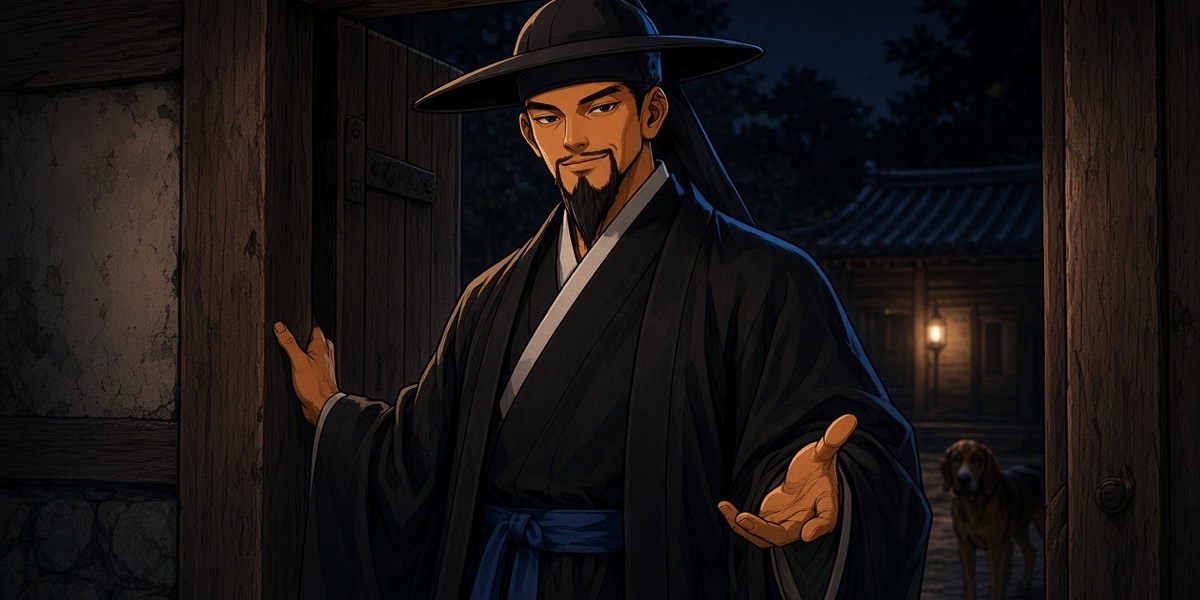
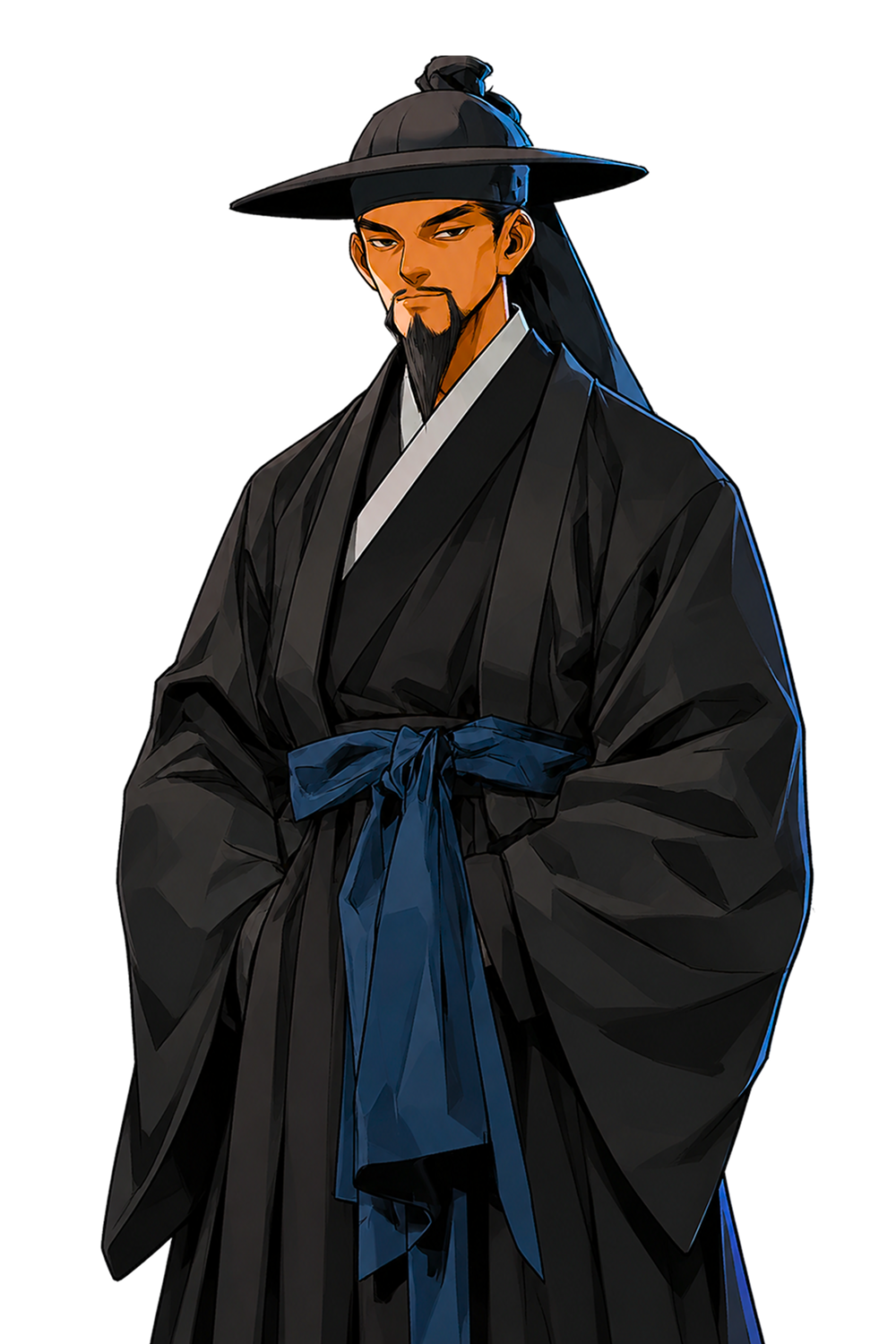
The house that buys her belongs to a magistrate. A thousand-year house. Dogs older than the roof. Daughters who speak before he does. It looks kind until it does not.
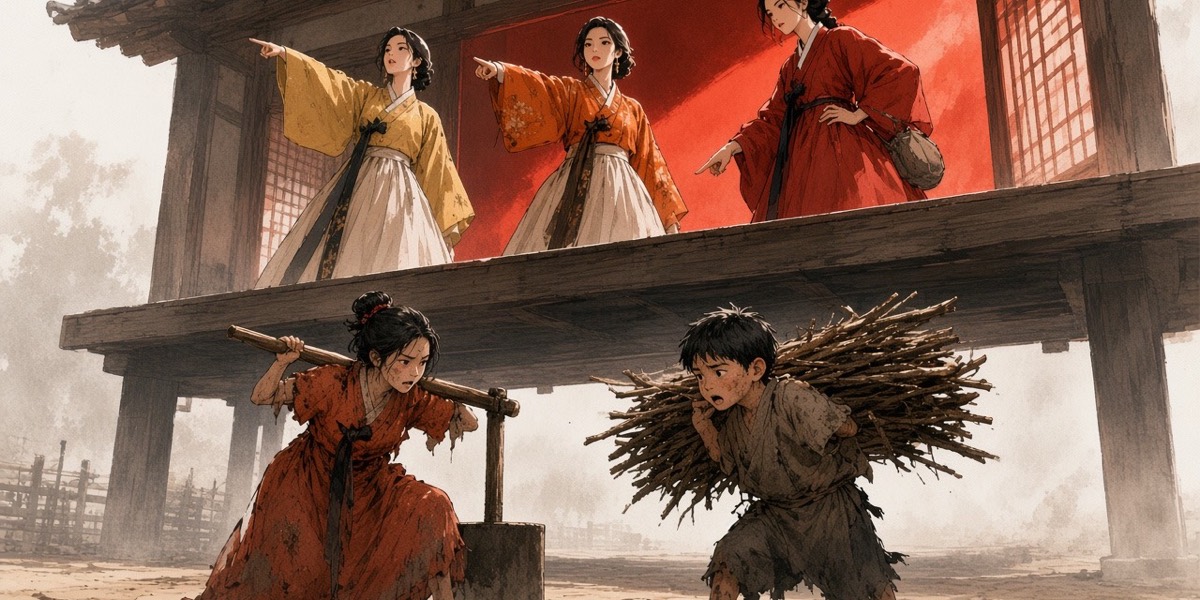
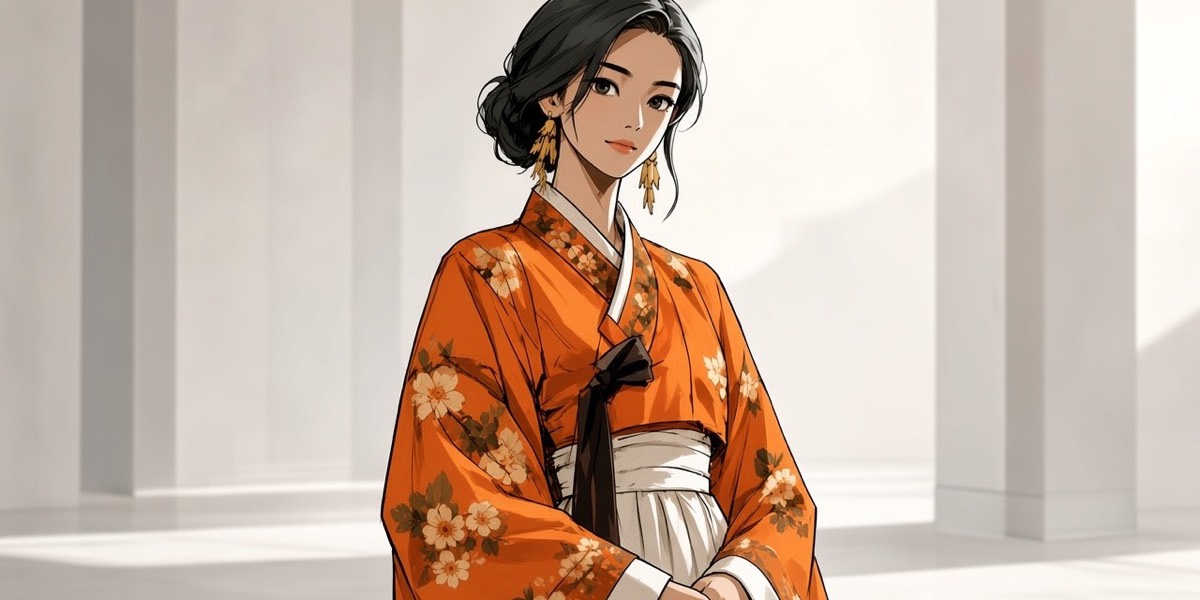
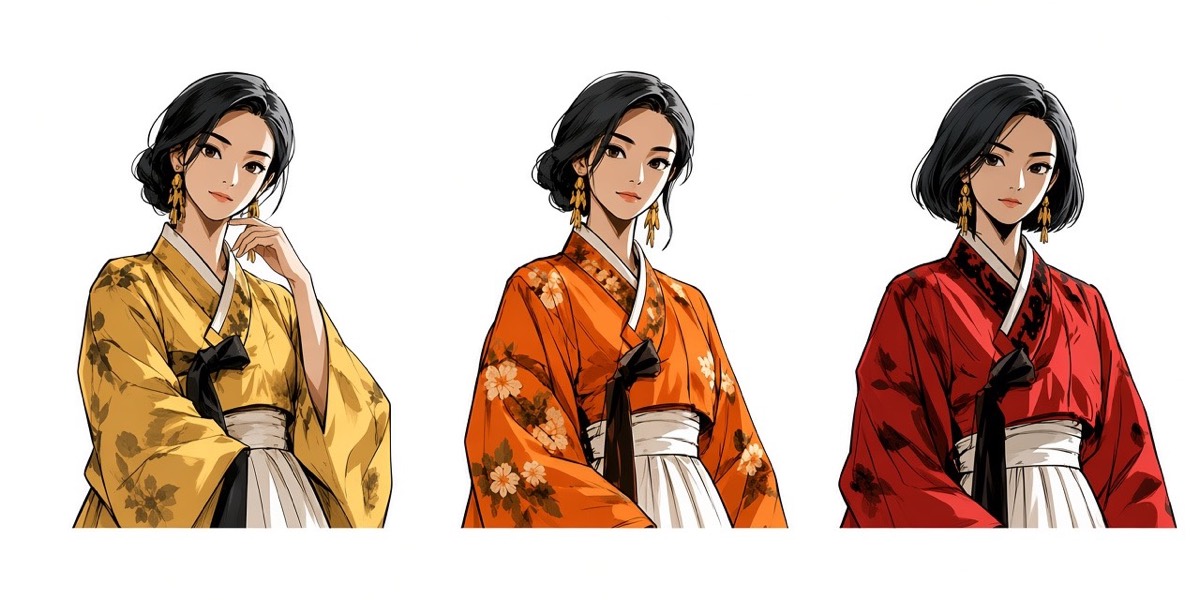
The first daughter — yellow silk, low bun — says no. The second daughter — orange silk, quieter — says no. The third daughter — red silk, bob to one side — looks at the pregnant woman the way you look at a tool that still has years in it.
The magistrate listens to the third. He always does. He pays three hundred for the mother and one hundred for what she is carrying, and he smiles as if he has bought a season.
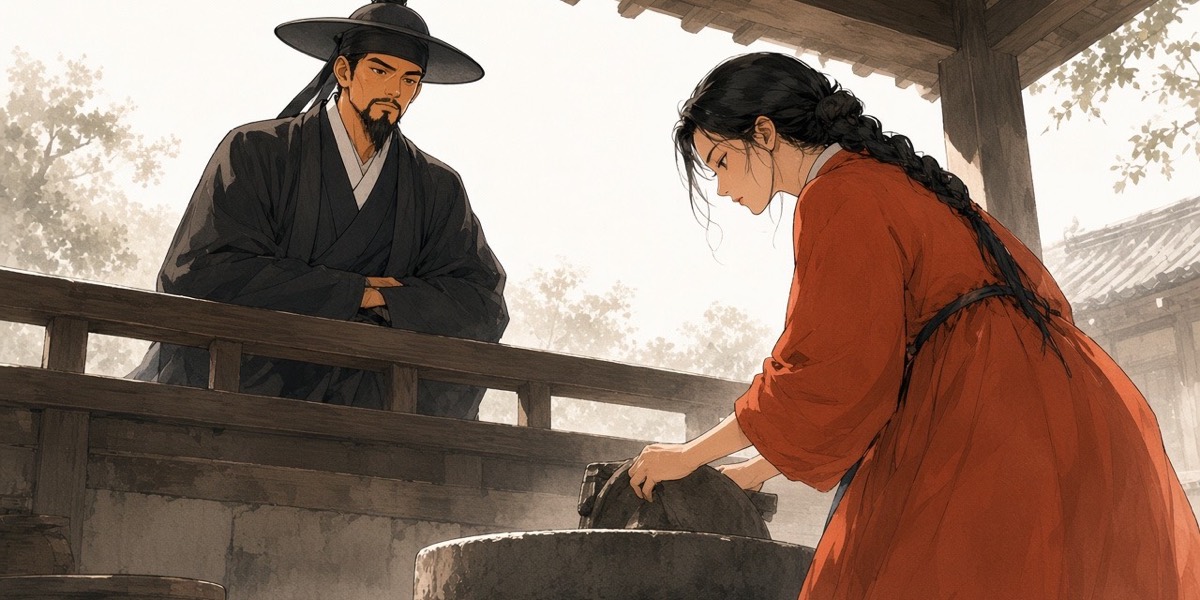
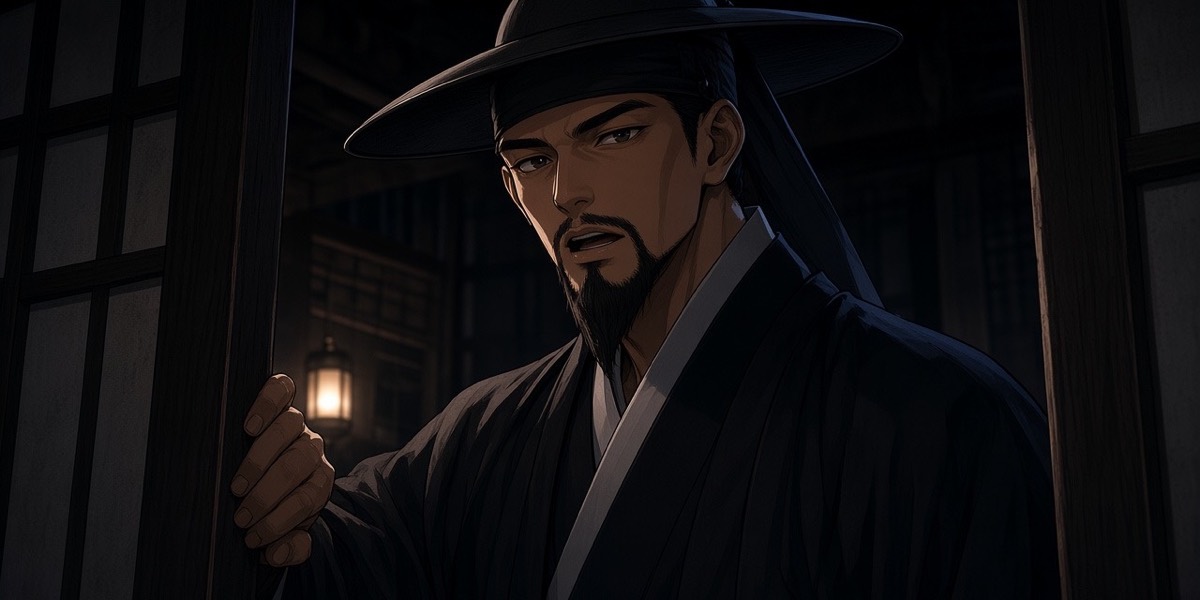
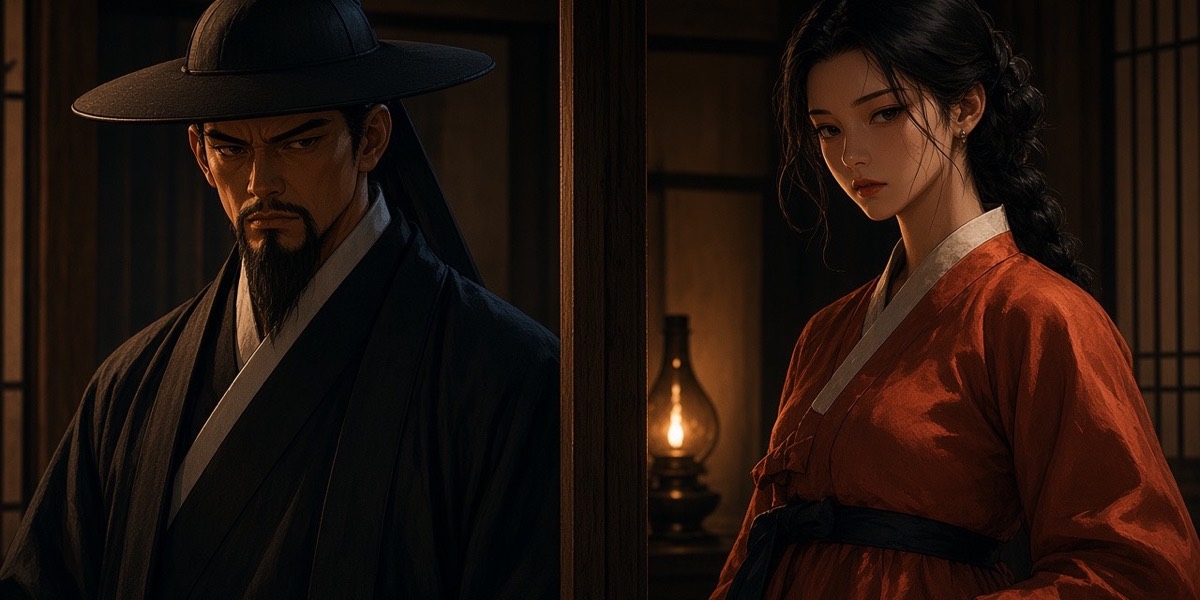
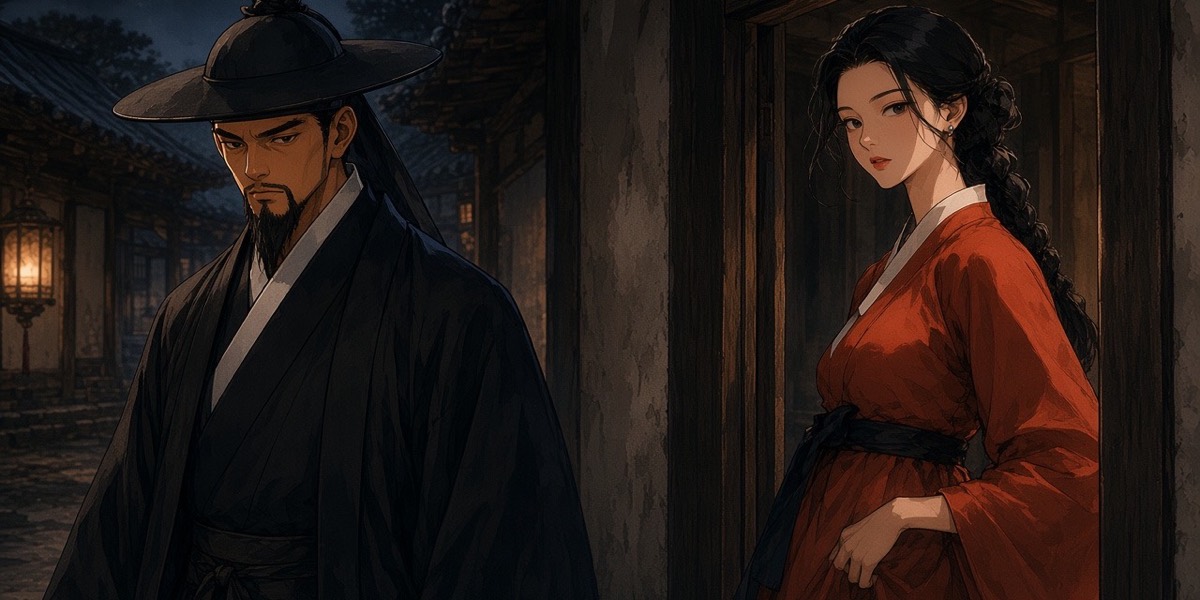
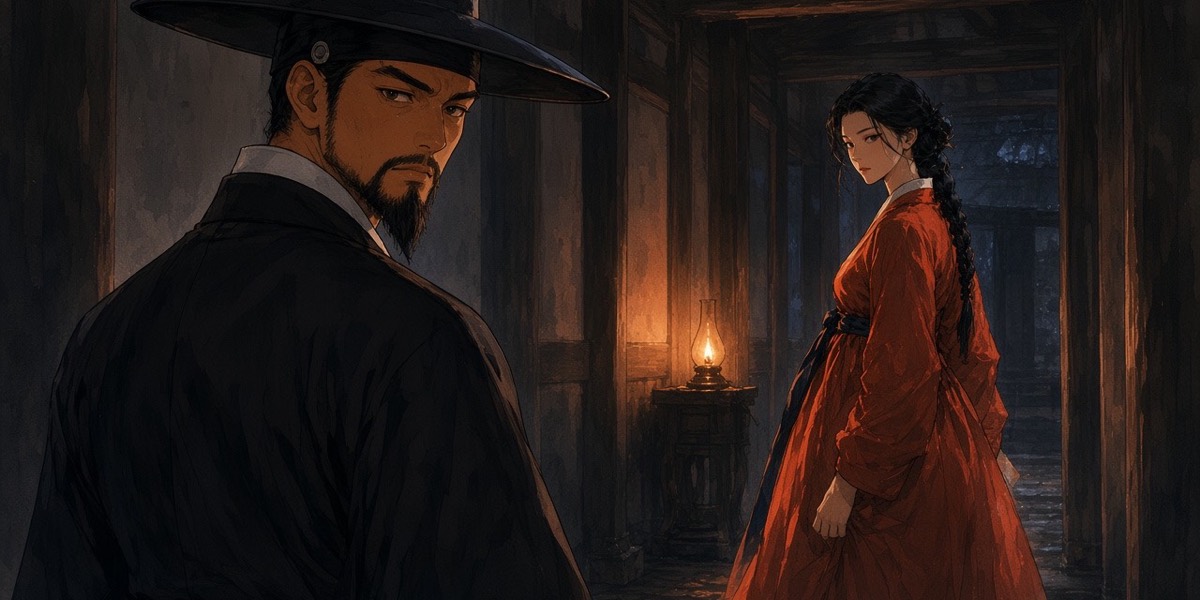
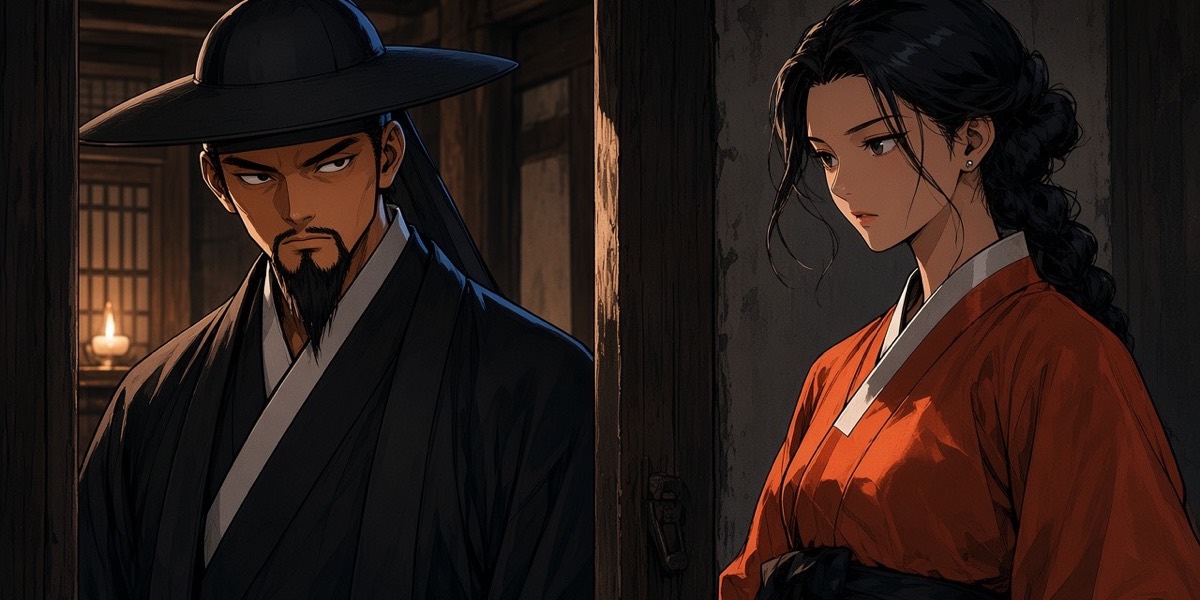
He comes to the servant room that night anyway. She is beautiful enough that half the island would have said yes by now. She says no because she is already married in the only way that counts — waiting. He could take her. He does not. Forced yes tastes like ash to him. He wants her mouth to mean it. He leaves. He laughs in the corridor, as if loyalty were a season that will pass.
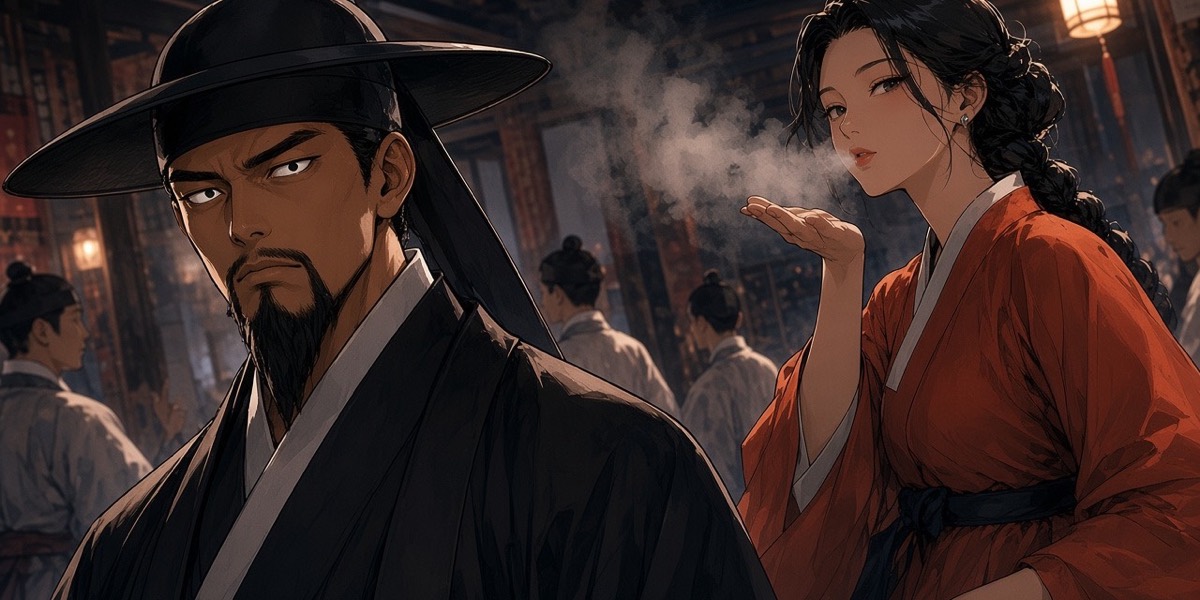
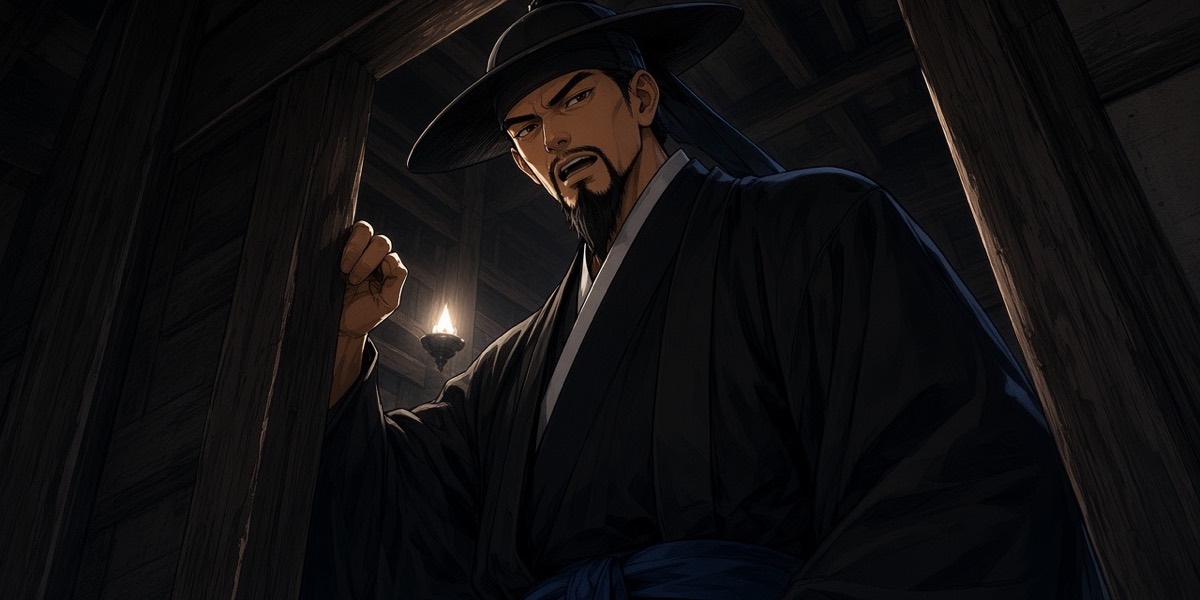
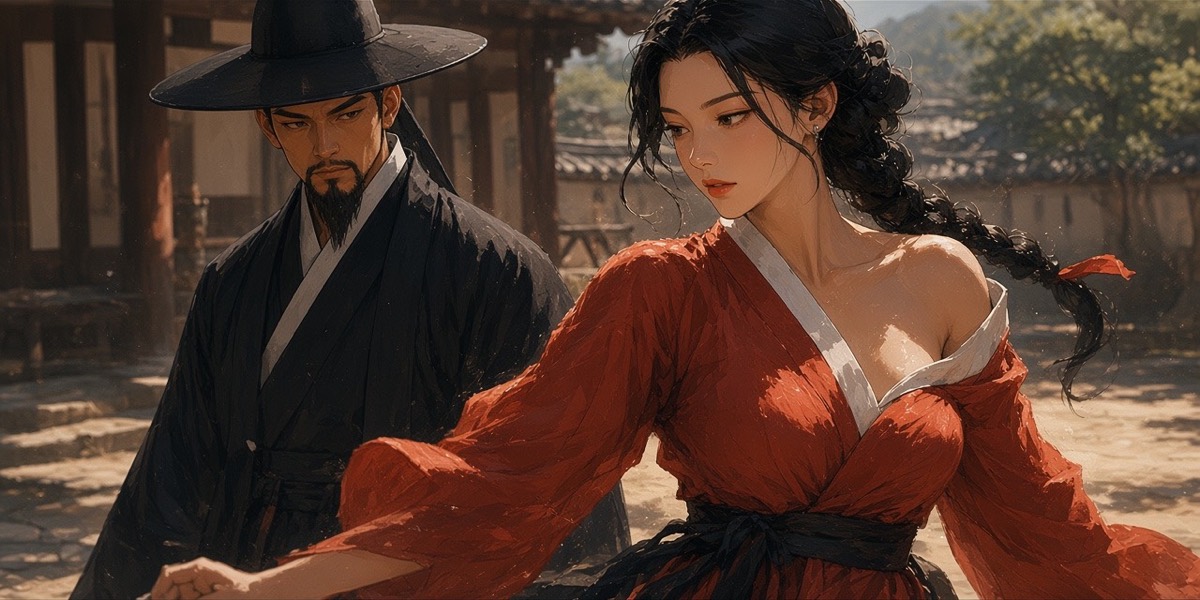
On the way out he looks once more. The vermilion cloth is wet at the collar. It sticks. He is a handsome man and he knows it — fit, hard under the black robe, the kind of face that usually gets what it asks for. She still said no. The shape under the silk stays in his eye like a brand. He does not touch her.
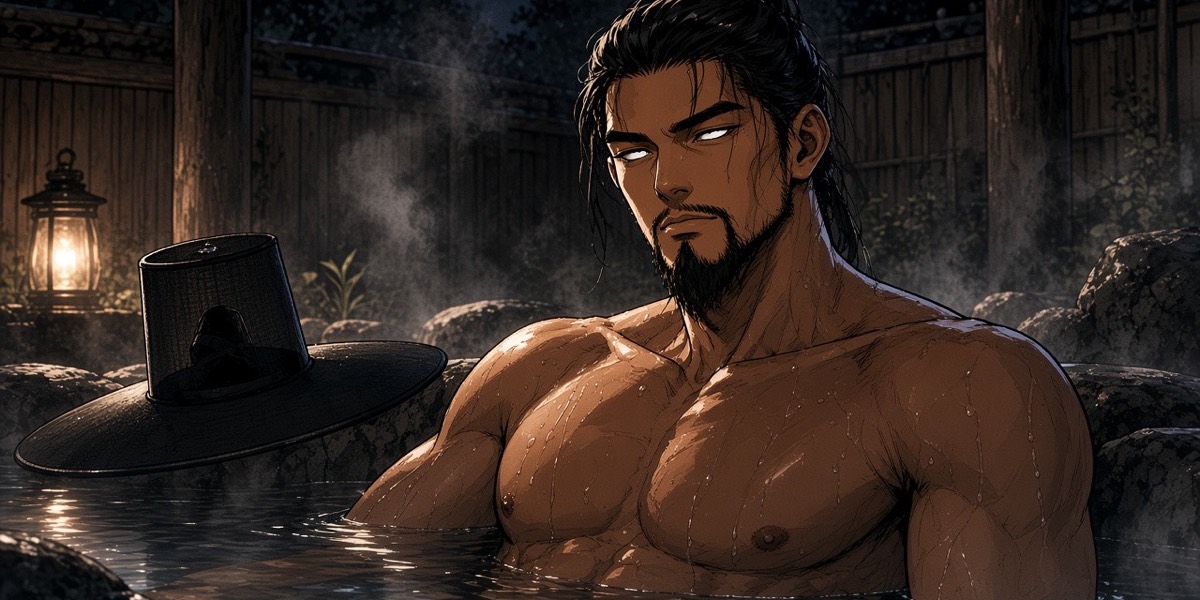
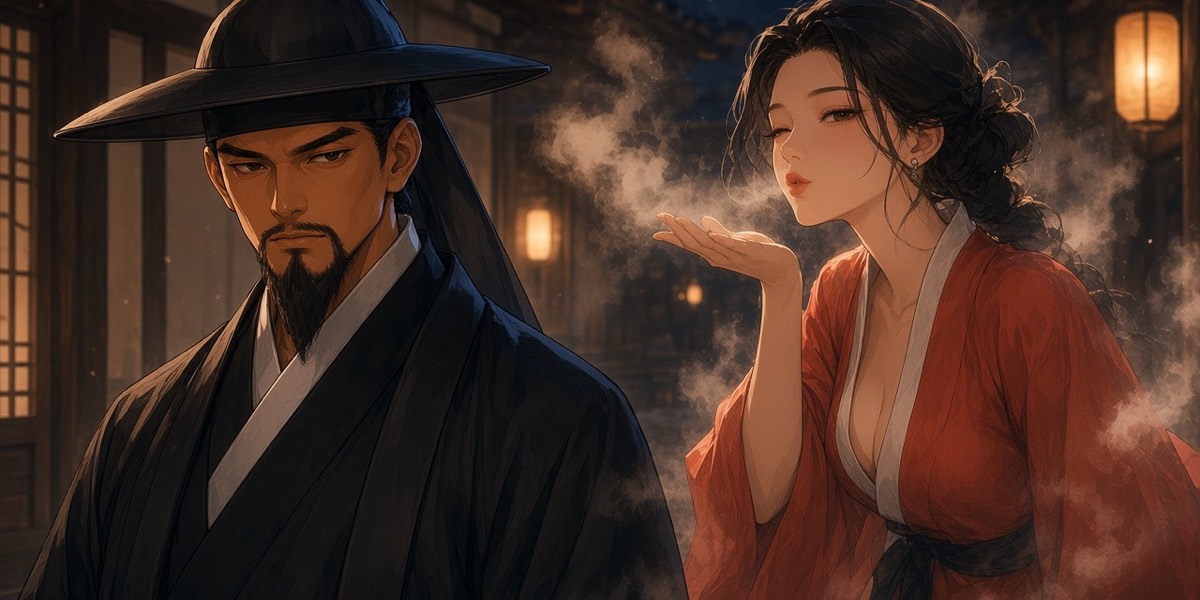
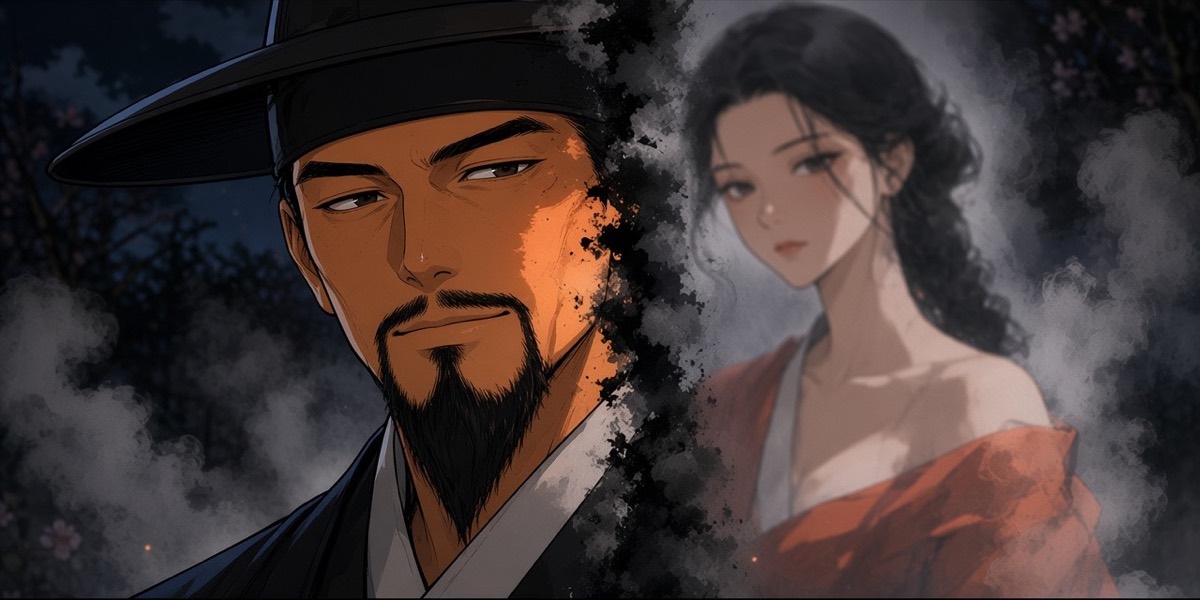
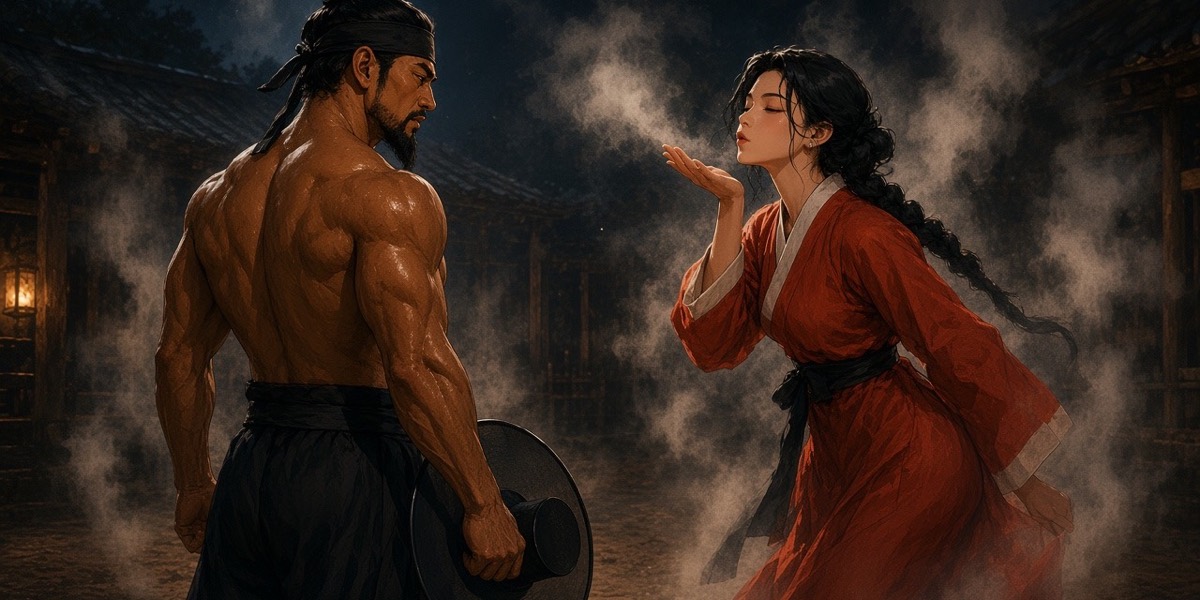
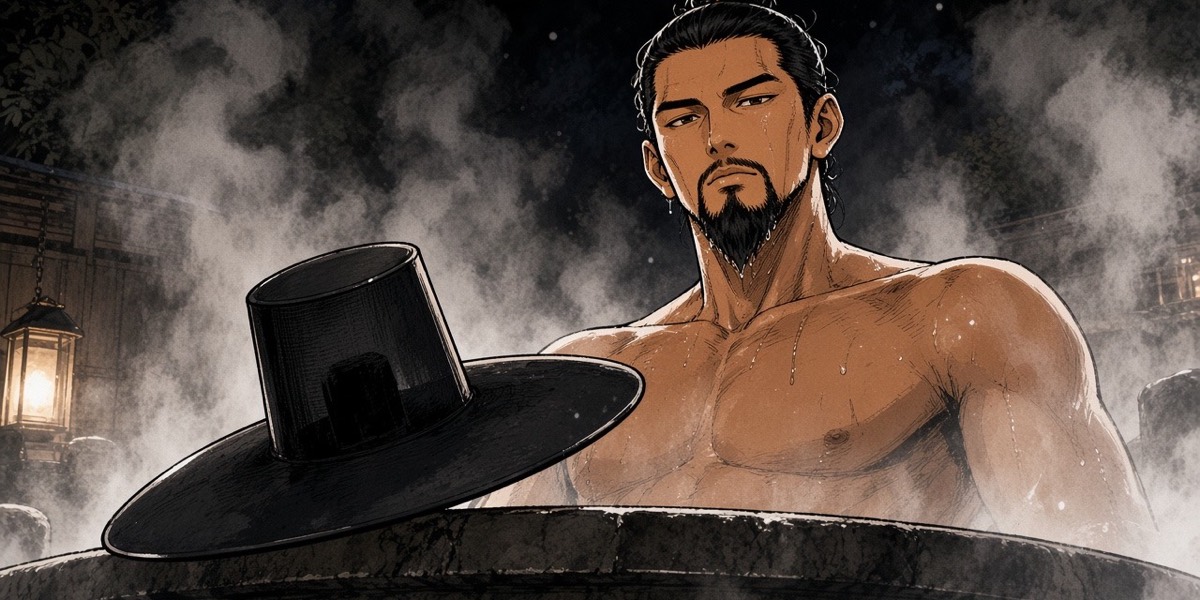
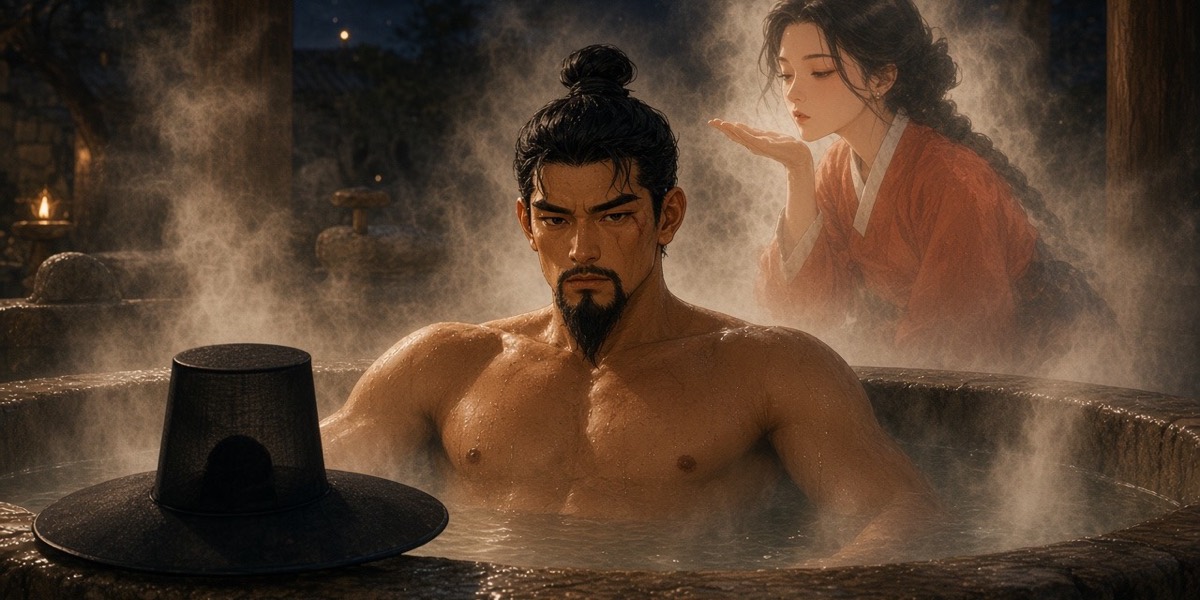
The backyard has a spring the roof paid for. Steam. Black stone. He peels the black robe off and sits in the heat with his chest bare, muscle still hard from the years he spent becoming the kind of man who buys people. He shuts his eyes. The water is hot. It does not rinse her out.
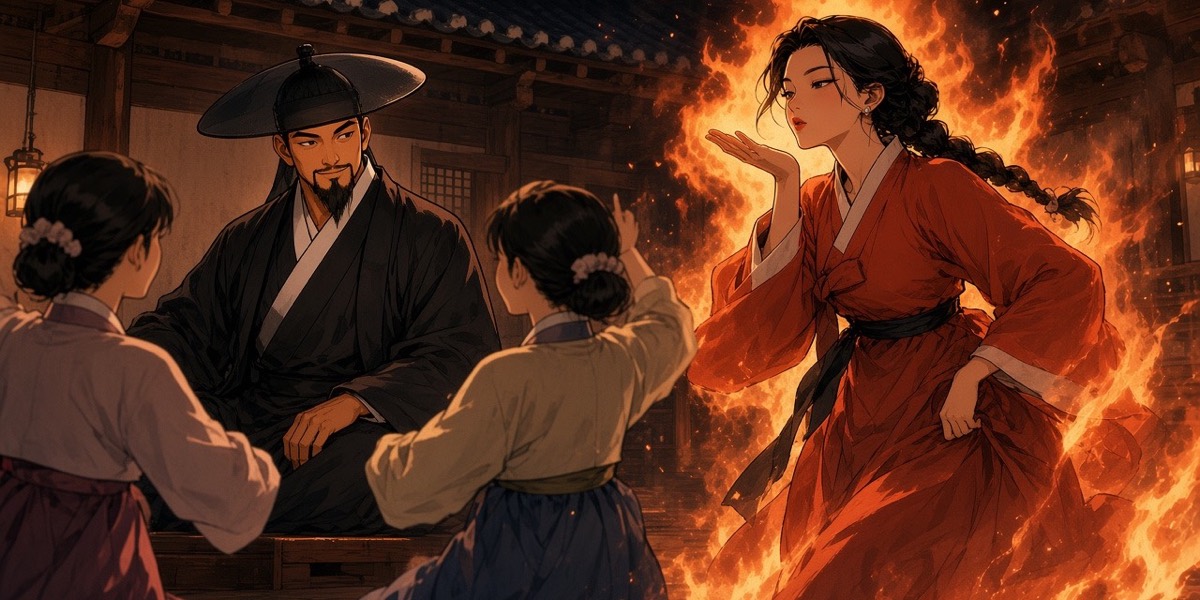
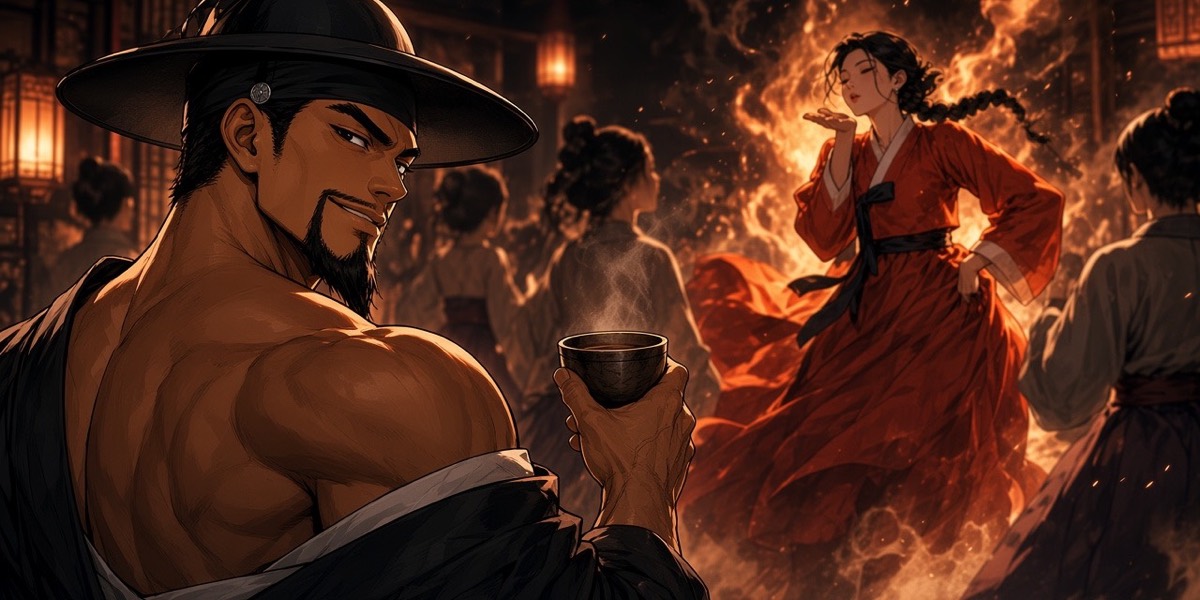
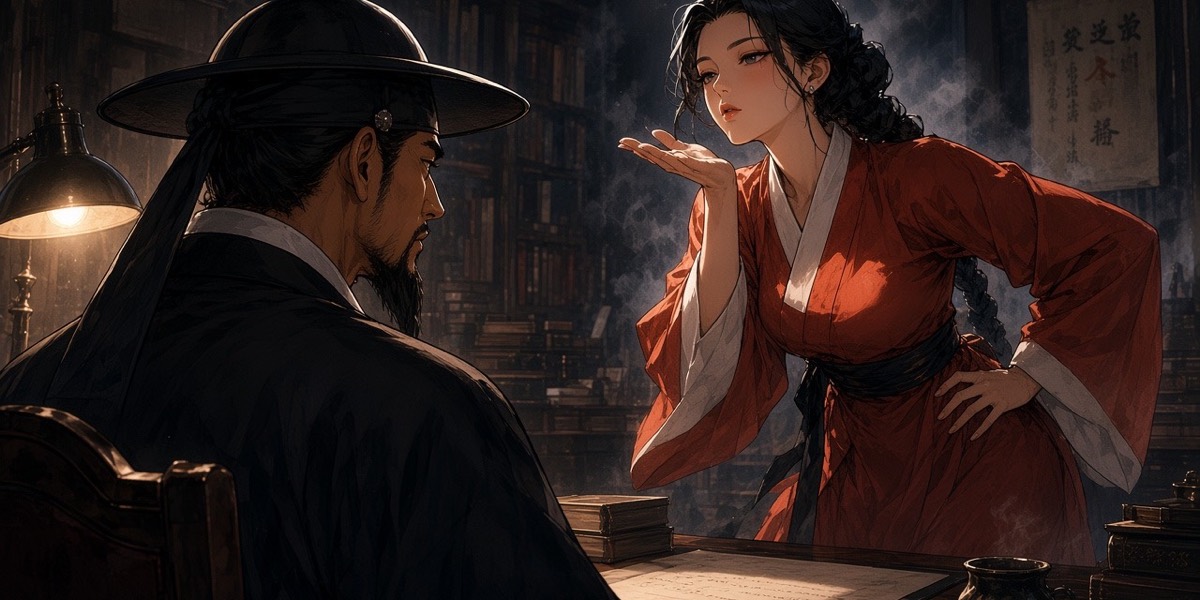
In the steam he is tormented by her. The fantasy is not the loyal wife who said no — she blows a kiss across the vapor, hiked vermilion silk, heavy-lidded eyes, the seductive yes he will never get from the real one. He will not invent that yes with his hands. The pictures still come. They do not let him sleep.
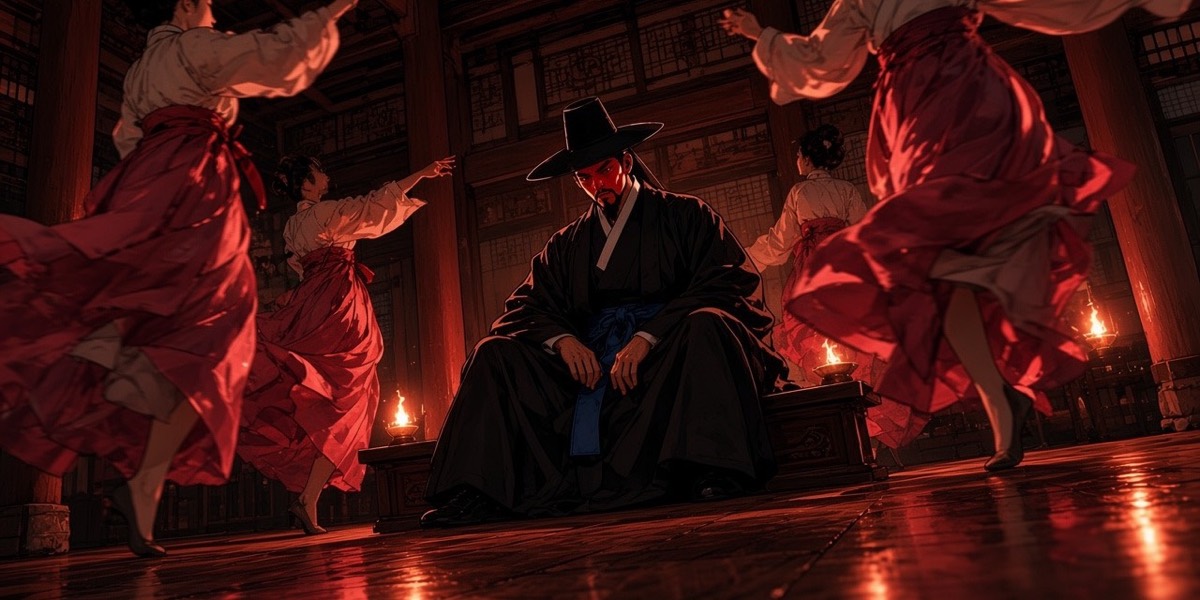
Some nights he sits in the main hall and watches the dancing girls. Silk turns. Ankles flash. Suggestive hips, open collars, the old banquet pleasure he used to finish without thinking. Tonight every other woman feels boring. He looks through them toward a vermilion servant who said no, and the stare he wears could stop a room.
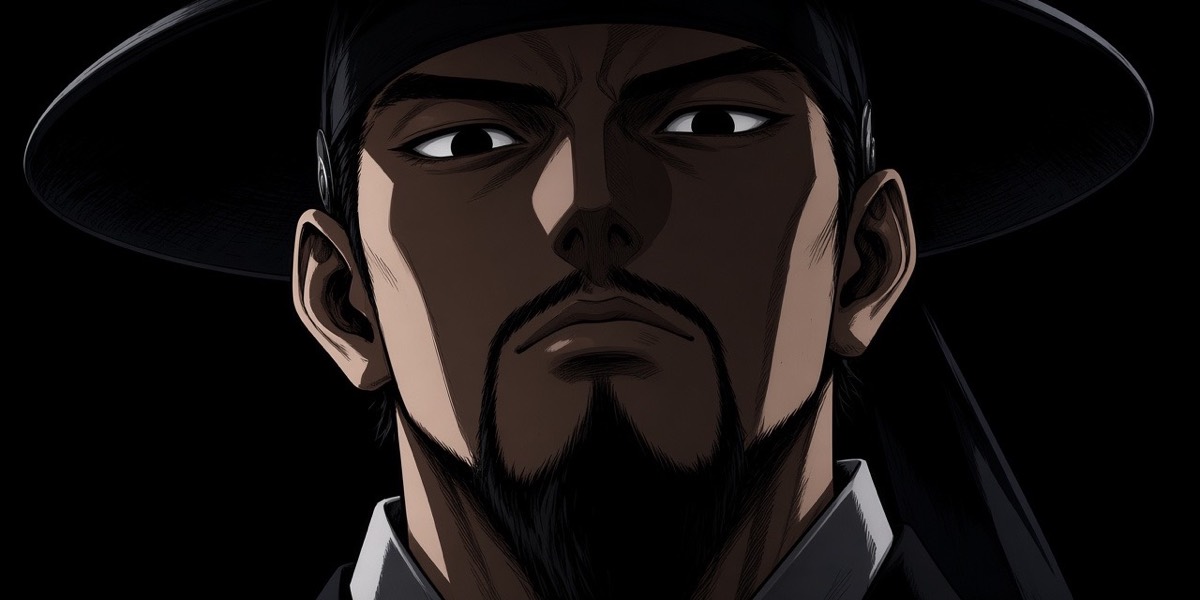
Before anyone speaks he is already gone behind the eyes. He stares through the dancers without blinking while fantasy- accents her waist for him in the smoke, winks, blows a kiss, turns just enough. His mouth is not soft tonight. No signature smile. Only the torment.
The dancers keep smiling. One of them — the one who usually gets his eye — stops mid-turn and drops the performance.
He laughs once, soft, and sends her back to the line. Alone again, the smirk dies. In the lamp smoke still performs for him alone — wink, blown kiss, vermilion silk accentuating every line of that tight little body, then an embrace he cannot keep. Hellfire of a small cruel house. Pupils black. Round-top gat catching the lamp. Under the black robe he is already hard.
Every banquet ends the same. Girls in silk trying to be enough. Him leaving early with the energy still trapped in his pants, walking straight to the yard.
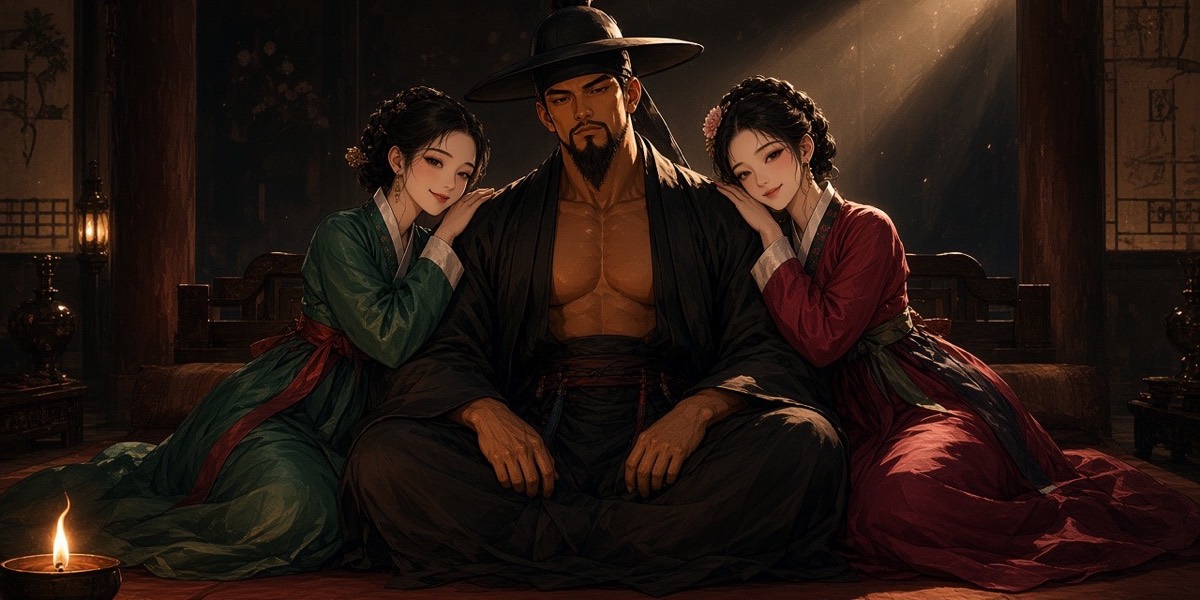
Some nights the bed is full. Dancing girls asleep on his chest, silk half-off, the old banquet pleasure arranged like furniture. He lies awake under them. Translucent sits on the dark beam above the bed — wink, cleavage in vermilion, a blown kiss — and every other body on him turns to water. He does not wake the girls. He does not touch the ghost.
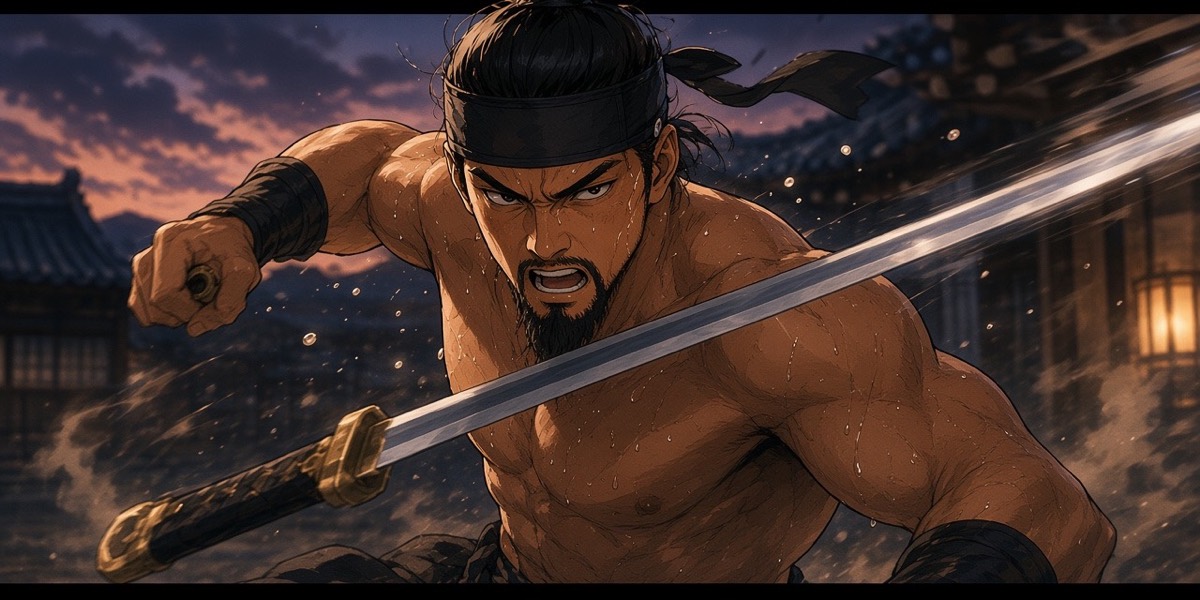
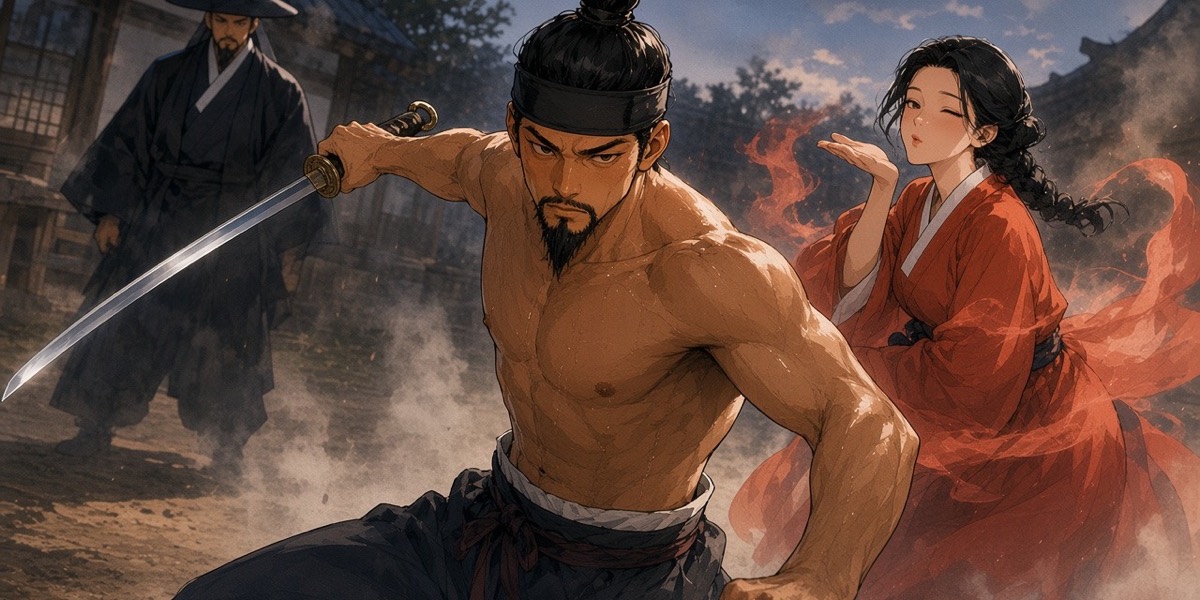
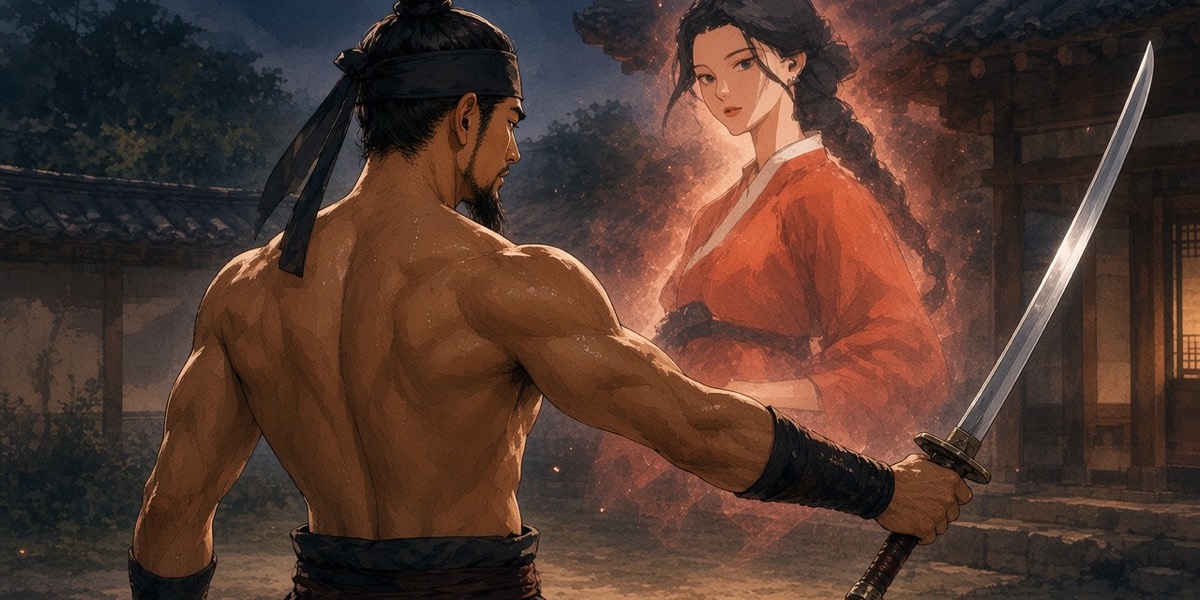
By day he trains in the backyard with a ring-pommel sword. Shirt off. No gat — bare head, athletic not bodybuilder. Sweat in sheets down a large muscular back. Forearm veins. The grunts get louder, uglier — he is trying to burn the lust out of his body and it will not leave. Dark trousers tight on the bulge he cannot will down. Translucent leans in the steam of his own effort — wink, blown kiss, tight little body under vermilion — and vanishes when he swings through her. The blade cuts air like he is carving a yes out of the world — the same stroke he will use later, when anger finally takes her apart for the crows.
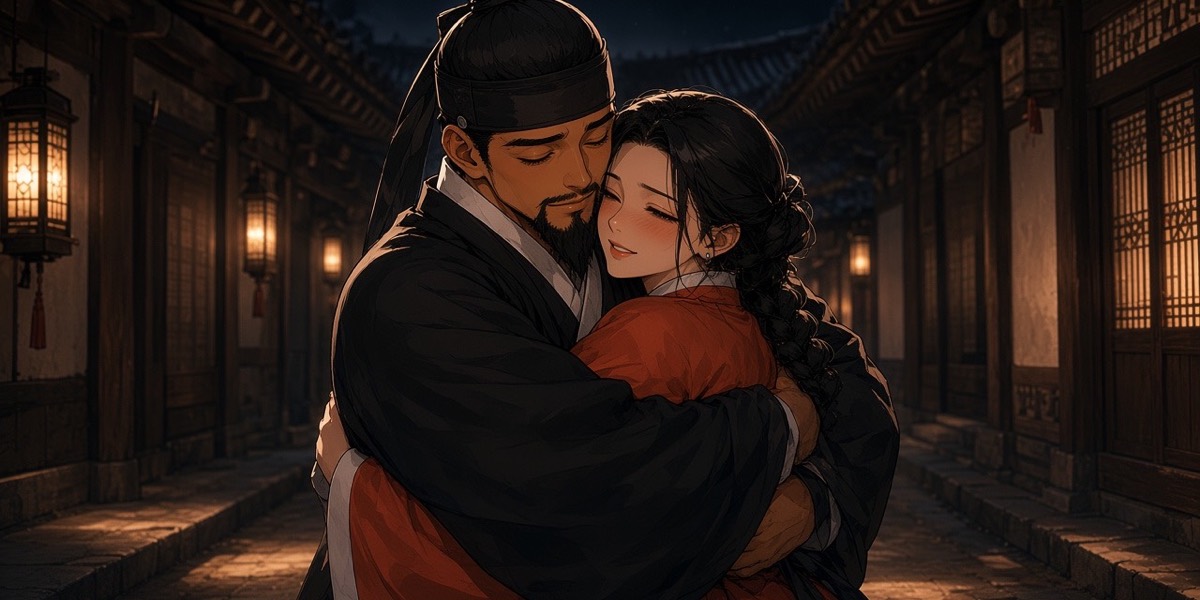
It does not work. Intrusive thoughts of ’s perfect tight little body follow him through his own household — the corridor, the mill, the spring, the accounts desk. Fantasy-her makes suggestive poses in empty doorways: hand on a hiked hip, silk pulled taut across her chest, a wink over the shoulder, a blown kiss that never lands. Sometimes she walks into his arms and he feels the embrace for a full breath before the corridor is empty again. His face goes flat — no smirk, jaw locked, eyes on nothing. He is sweaty, muscular, irredeemably horny, and silent about it. The servants look away. does not watch. That is its own insult.
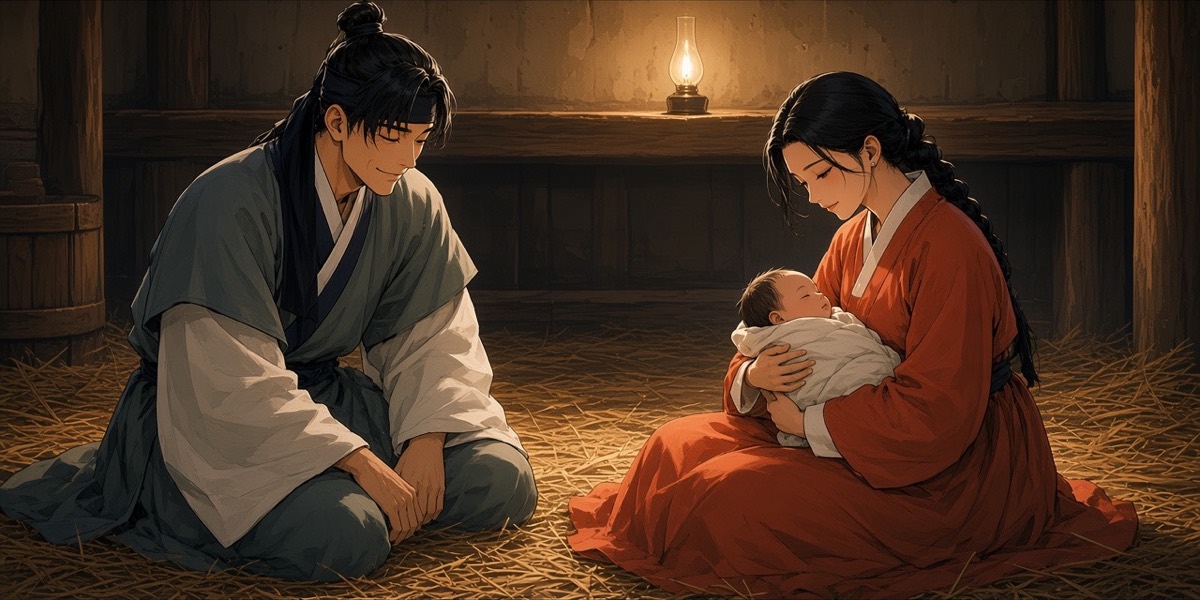
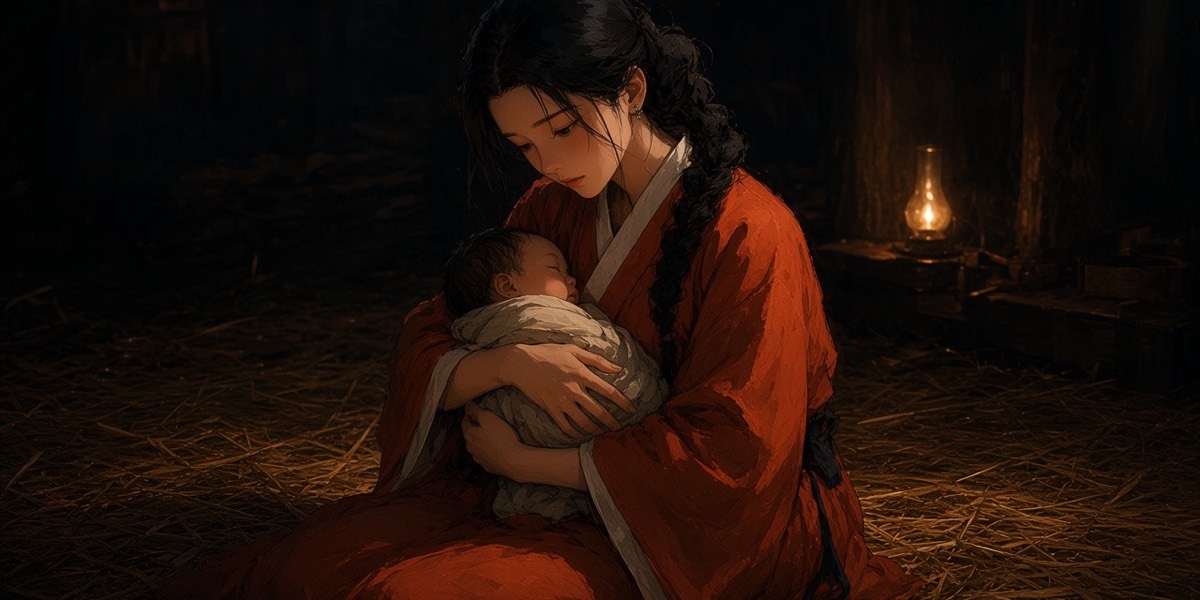
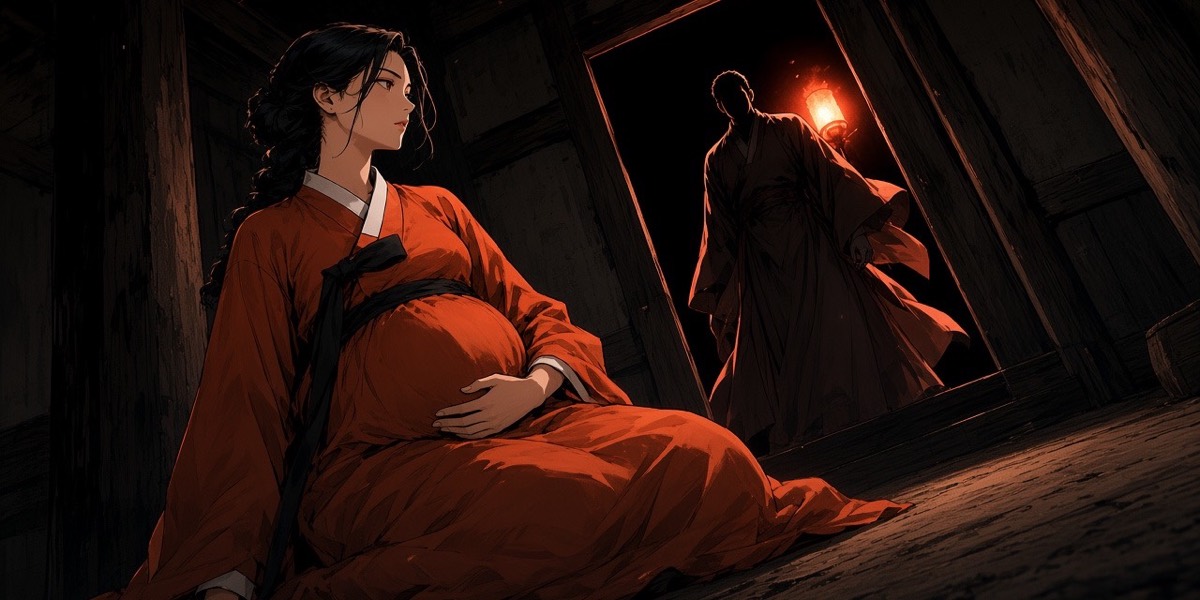
Her son is born in the servant room. Labor. Blood on the straw. She holds him wet against her chest and names him before she can breathe right — the first time the name is said aloud in that house. The magistrate does not bother with a name. He has work.
He comes back the night of the birth. She invents another rule: in her country, you remarry when the child can plow. He hits the doorframe on the way out. The third daughter, from the dark hall, suggests they use the woman and the boy as labor instead of killing her. The magistrate likes that better. He always does, when the third speaks.
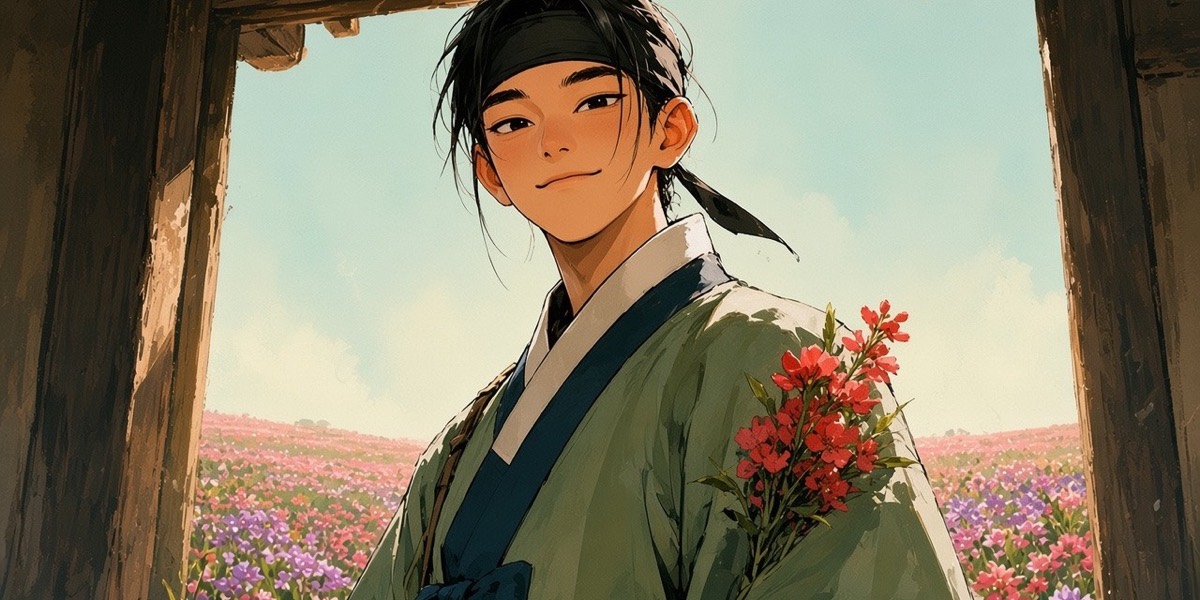
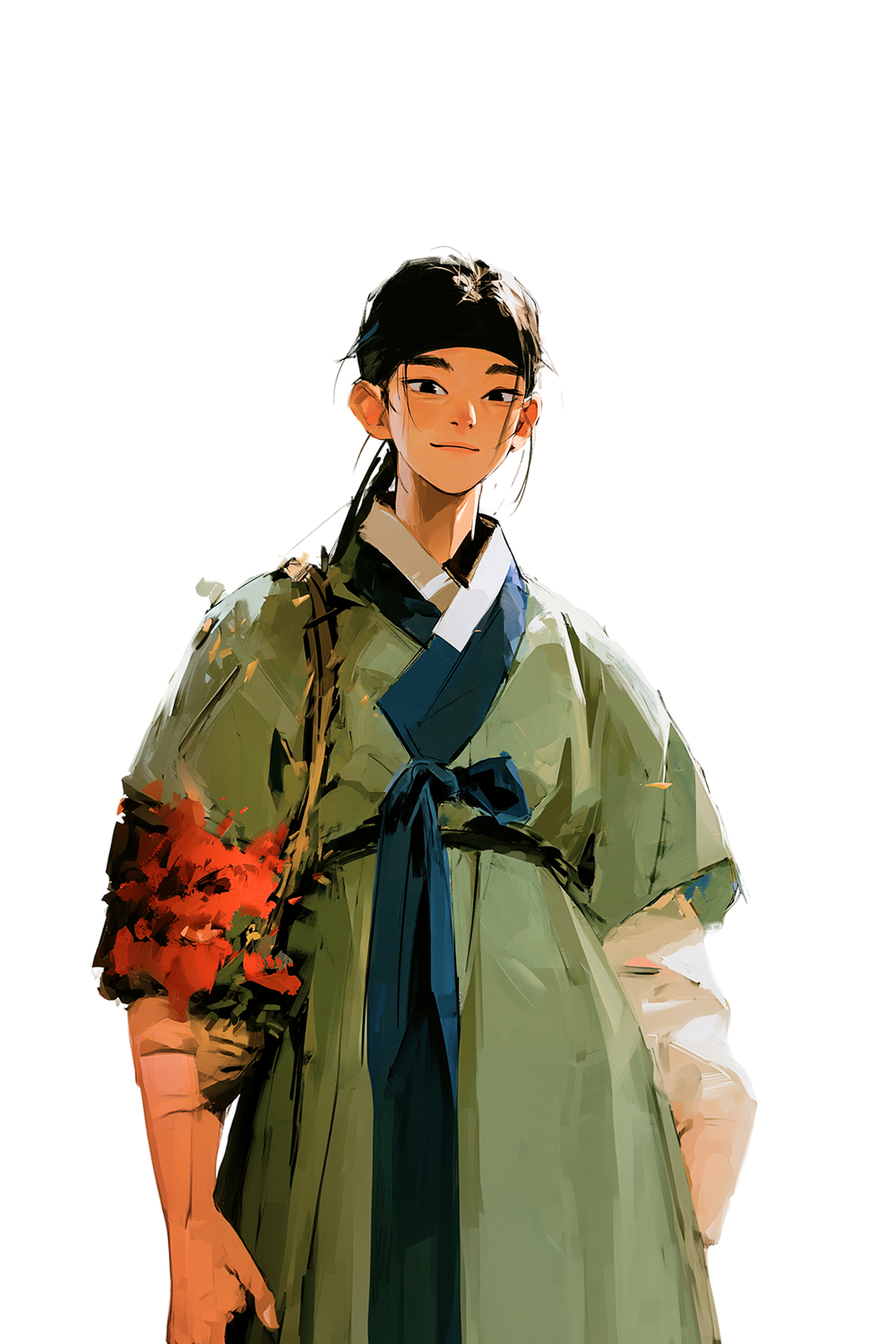
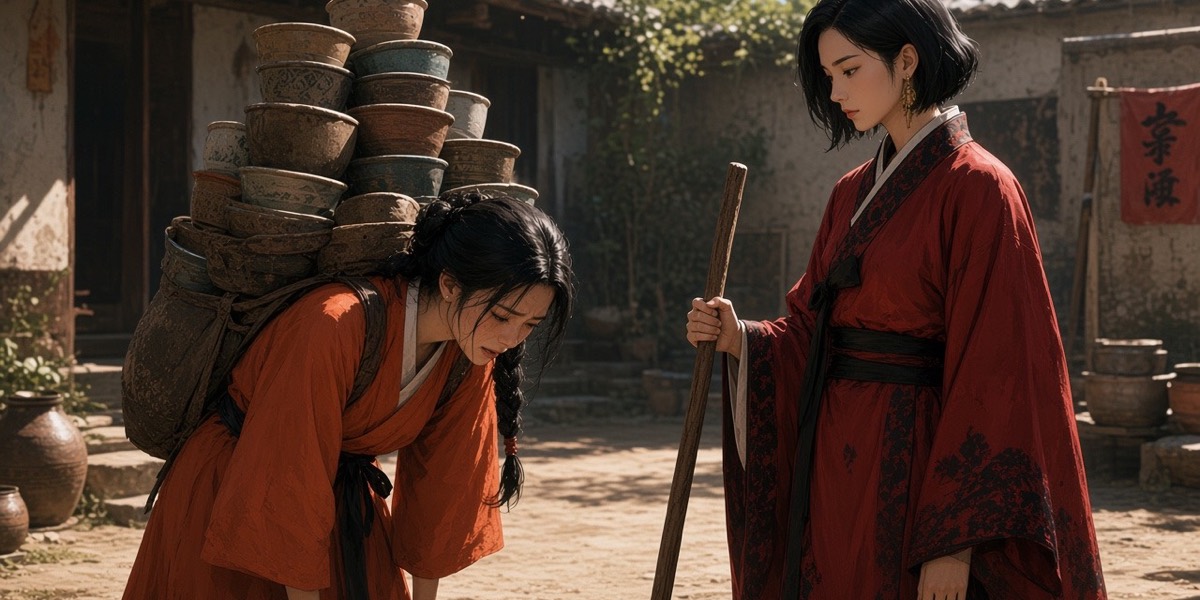
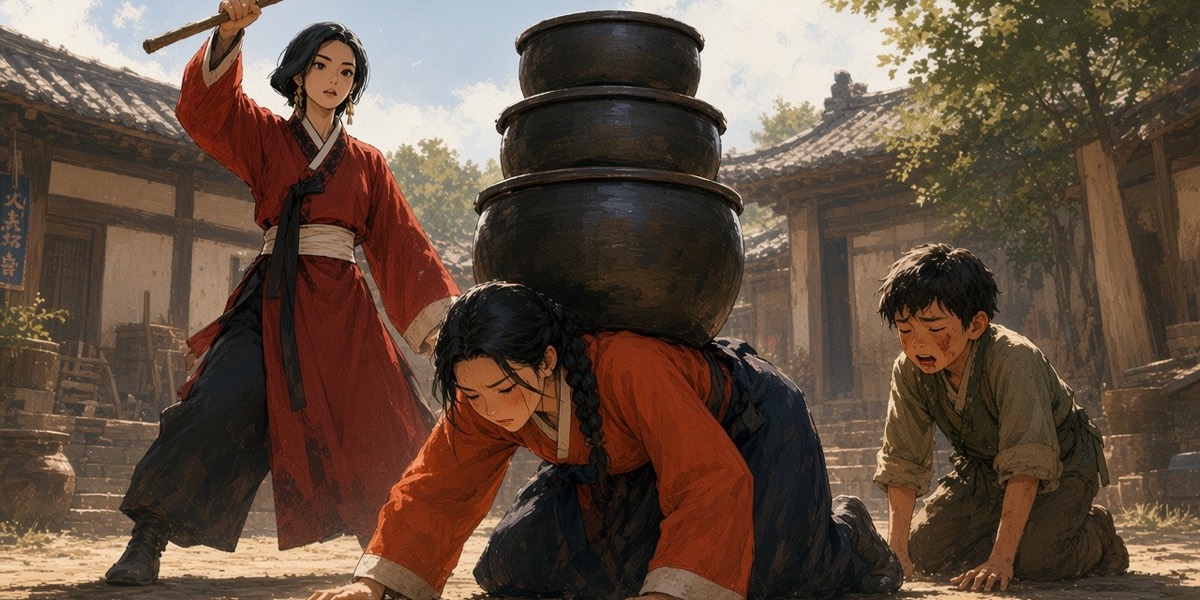
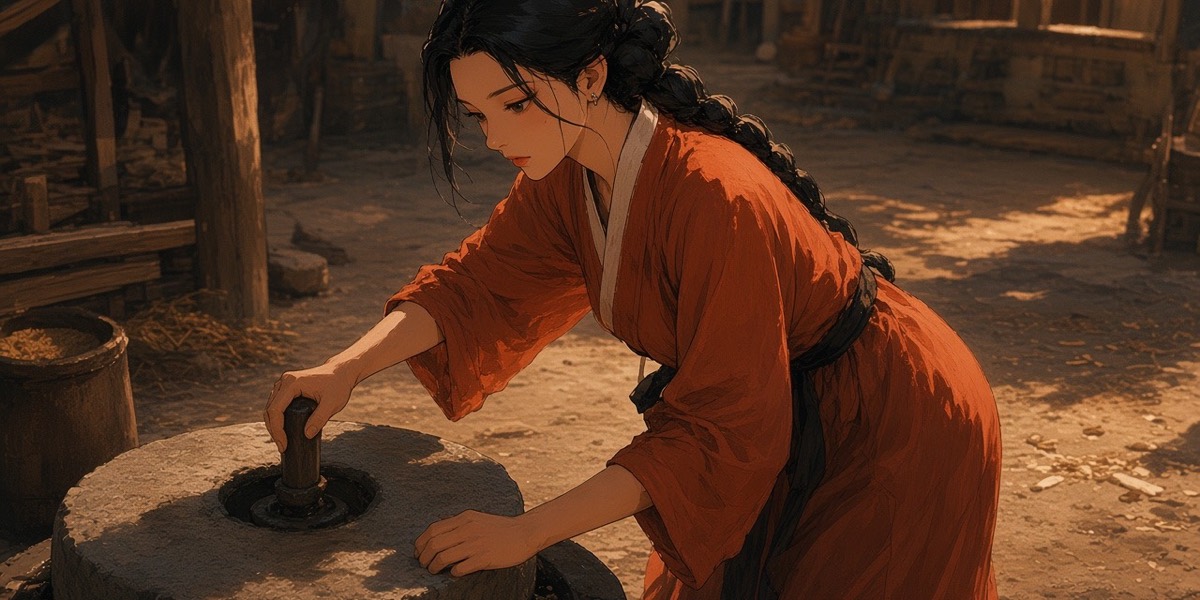
She says no for fifteen years. Not because he is ugly — he is not. Not because the house is poor — it is not. Because asked her to wait, and she keeps that like a vow. Through the mill, the beans, the yard, the night knocks. Five bowls of water on her back by day. Three more bowls built by night. When the boy can walk, he logs fifty trees before supper and twists fifty knots before sleep. The magistrate counts both.
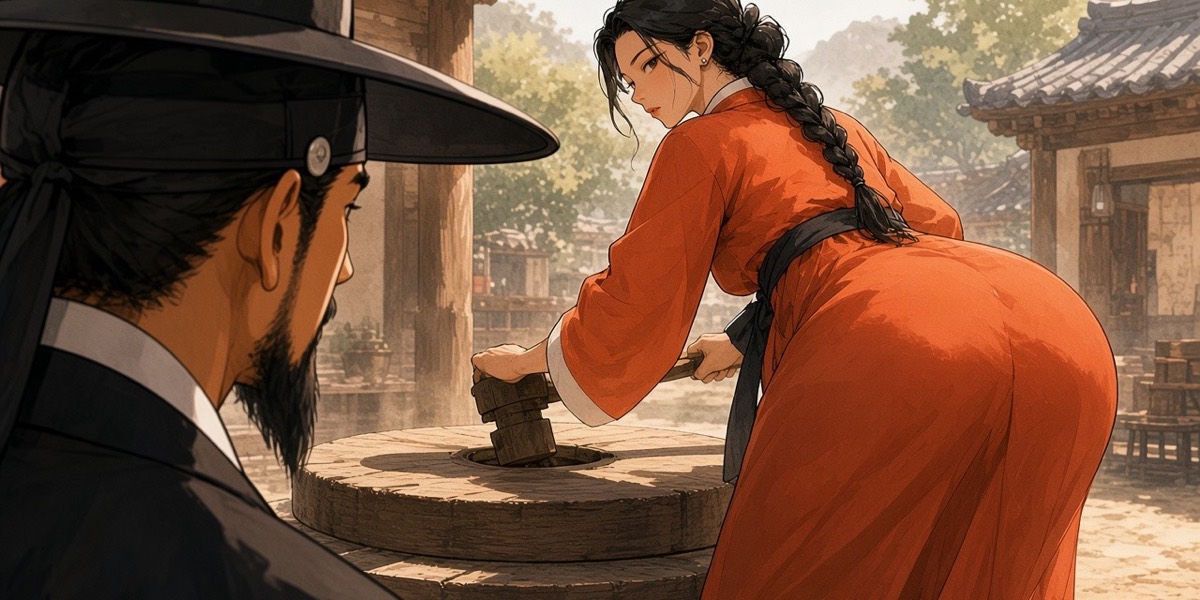
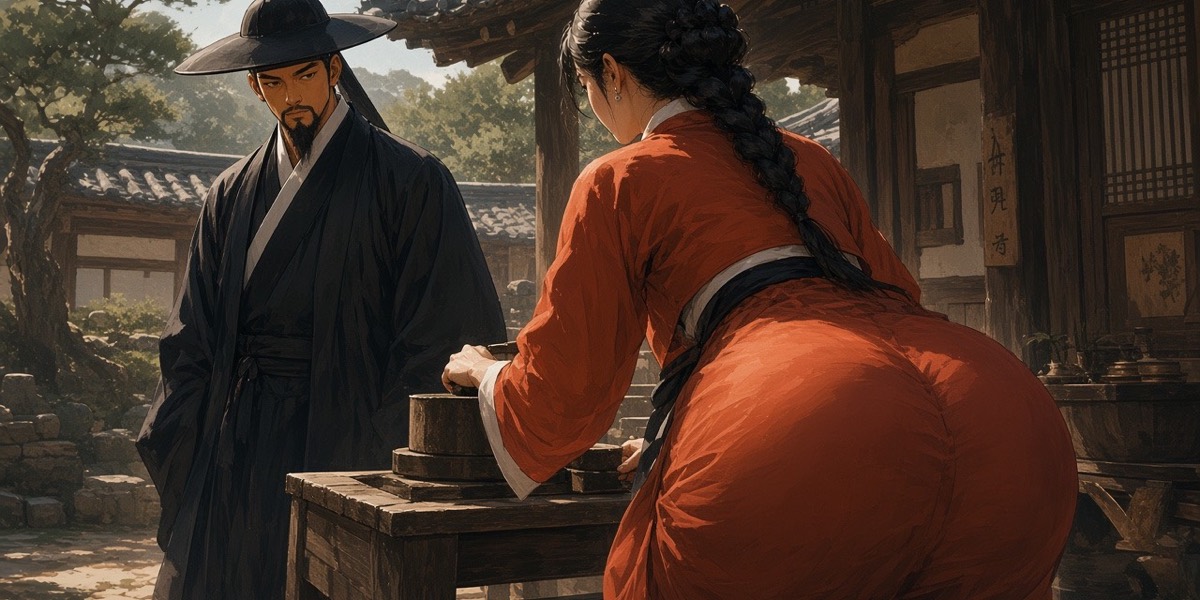
He watches her in the yard more than he watches the accounts. When she bends at the mill he starts at her backside — vermilion cloth pulling tight across that perfect shape — then the small slips: a collar that falls, a shoulder, the braid sticking to sweat at the nape. That tight little shape under silk he cannot stop inventorying. He tells himself it is work. He is lying. He is hard again by noon.
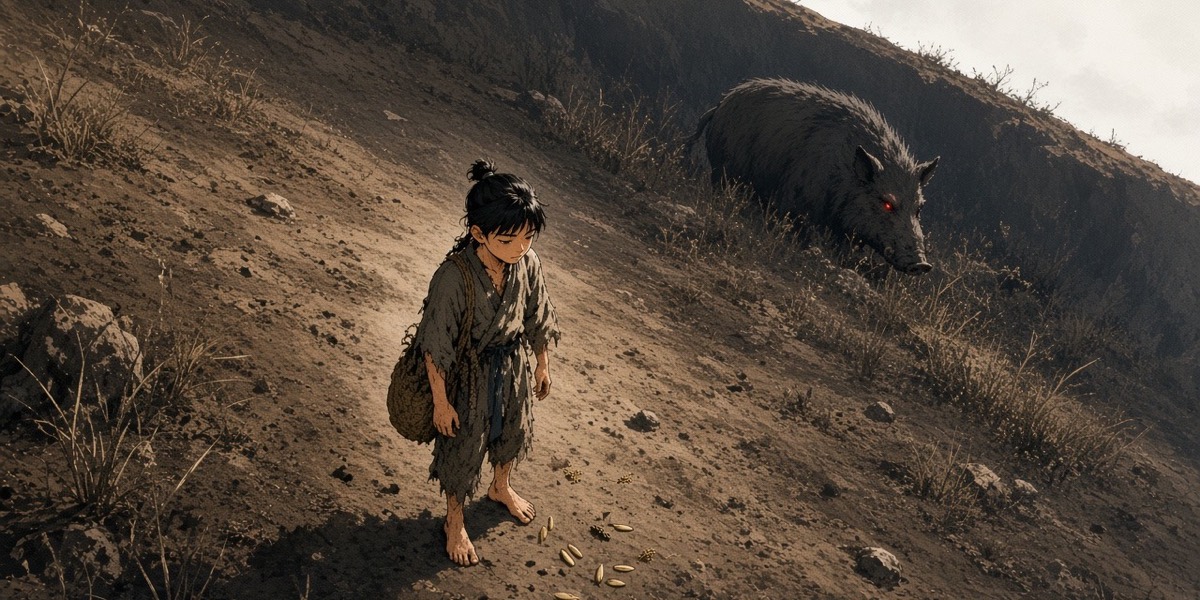
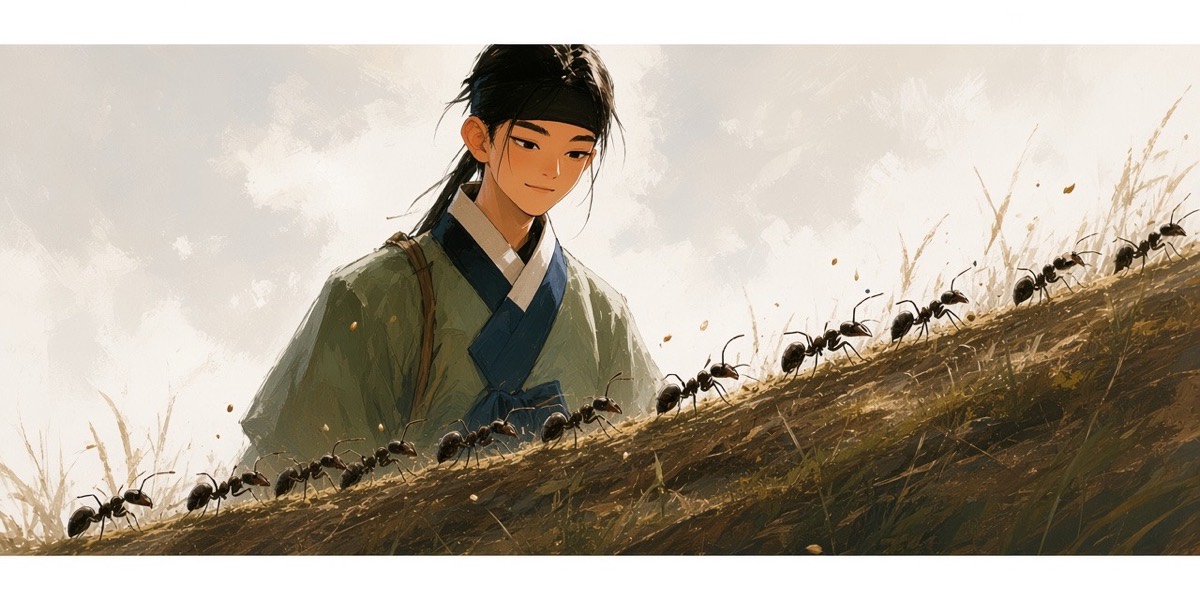
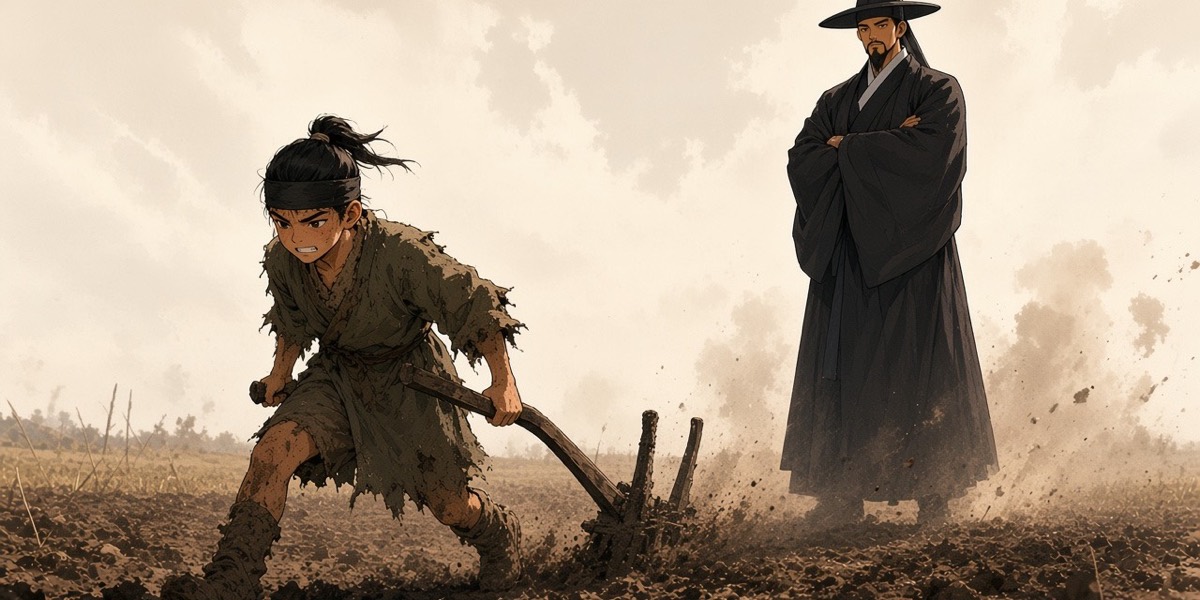
One morning he sends the boy to clear a whole mountainside and seed it with millet before the sun drops. A wild boar the size of a shed walks out of the brush and knocks the trees flat for him. Carpenter ants stack the seed when changes his mind and wants every grain counted twice. Later, when the bowls of water are impossible, the ants carry wet earth in a black ribbon up the hill so the boy can finish before ’s stick finds him again. The house calls it luck. It is not luck. Something on the west road is already answering him.
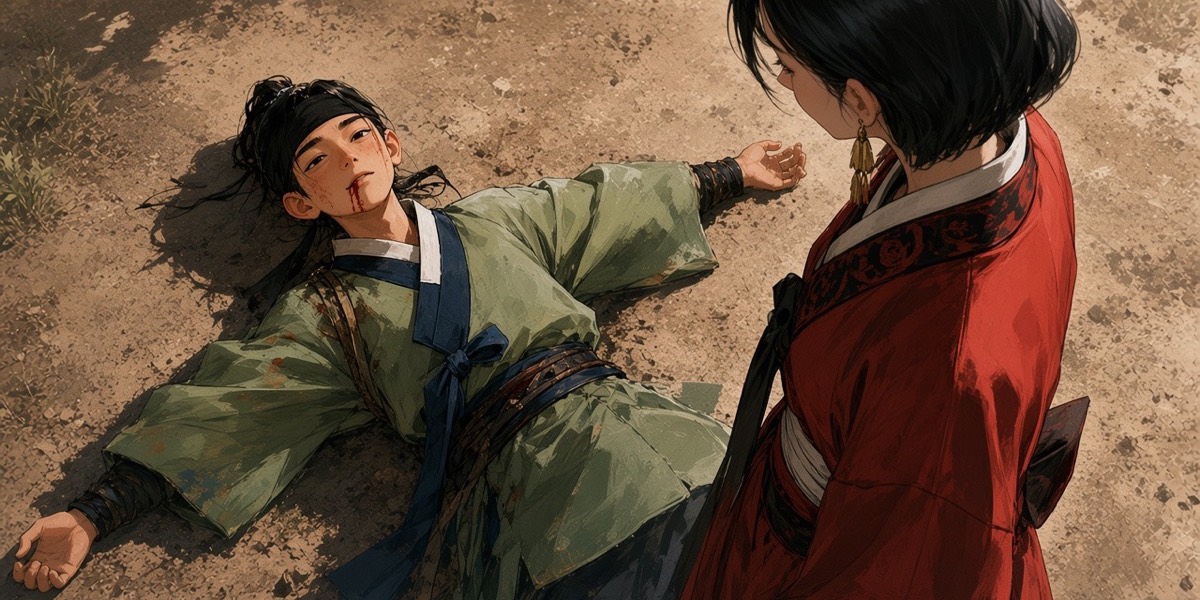
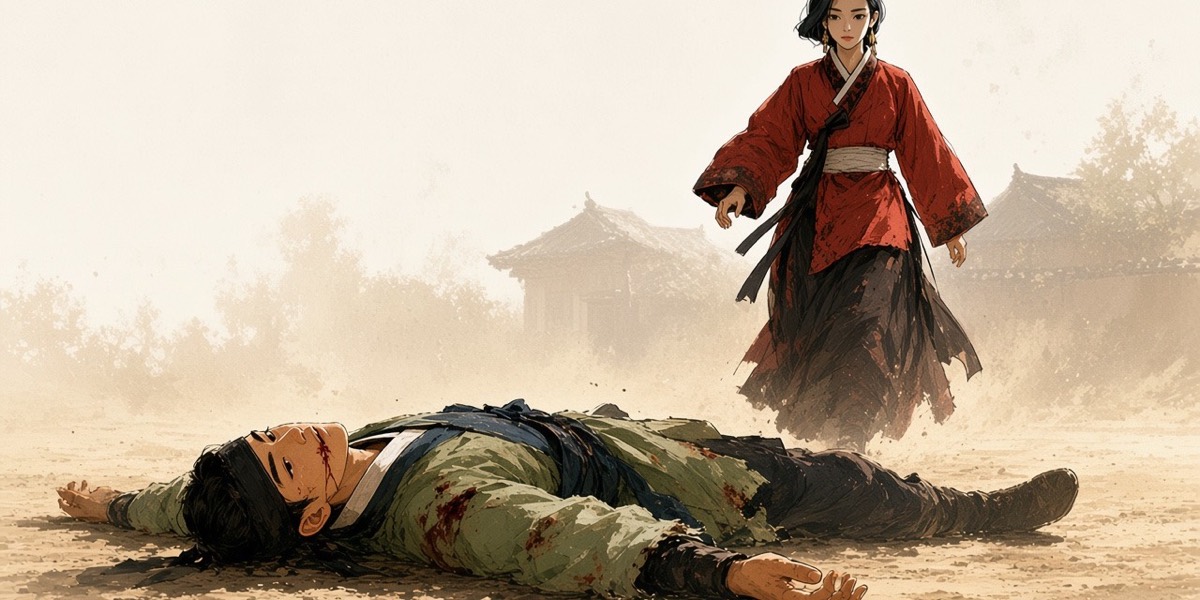
The daughters find the work. The first watches. The second looks away. The third — red silk, bob — invents the hours. She puts the stick in ’s hand and the water bowls on her back. She puts the boy on the packed earth when he falters. Blood on his lip. Blood on the yard. ends one afternoon on his back in the dirt — limbs flung, chest heaving, the Yamcha sprawl of a body that has run out — while stands over him and counts the bowls his mother still owes.
When the boy is ten, puts a plow in his hands and a cow in front of it. That night he goes to the mother’s door again. Her excuses are running out. You can hear it in how carefully she speaks.
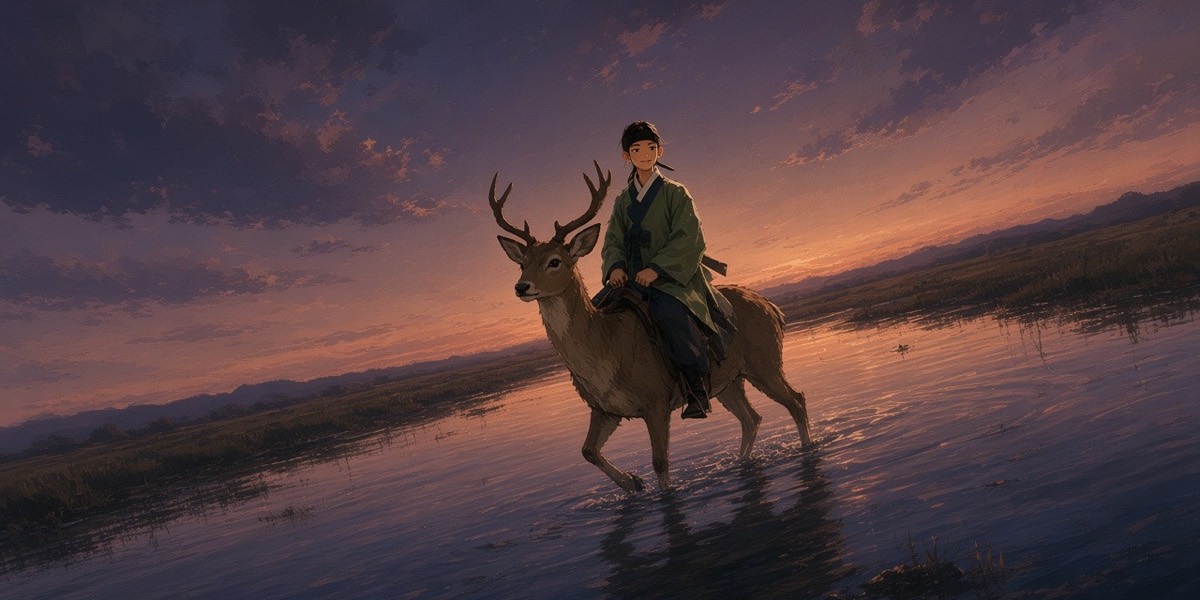
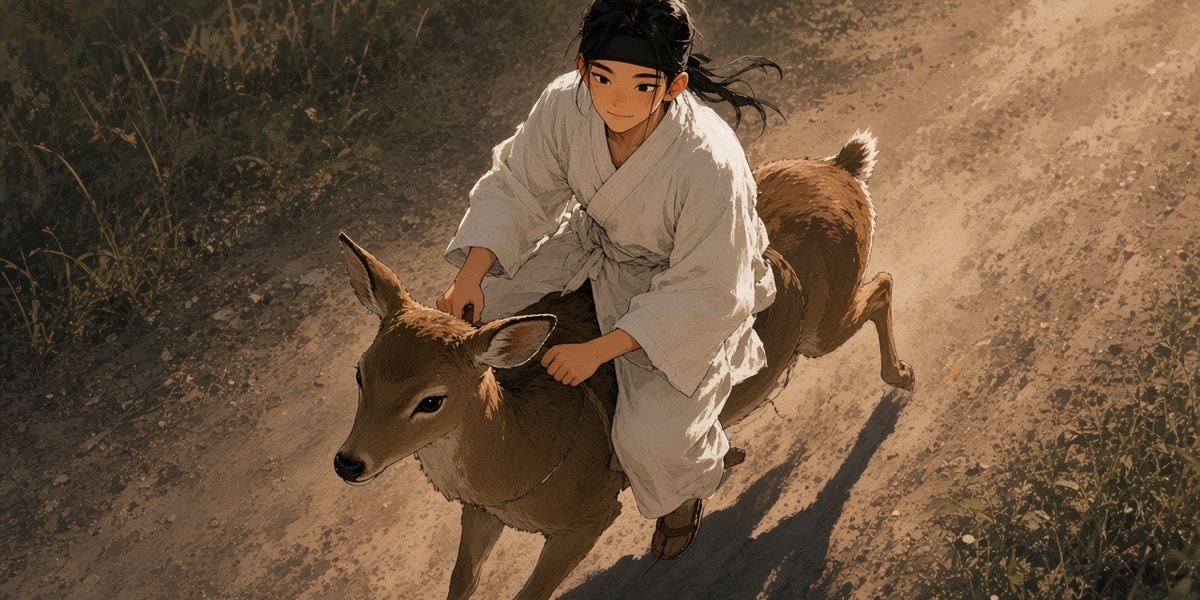
The boy is old enough, by then, to want a name that is not servant. In the woods where he logs, old men play baduk on a stump and tell him to catch — the divine deer of — and ride it west. He brings the deer home first, because he is still a servant, and asks his mother who his father is. She will not give it. So he does a cruel thing. You should know that, before you like his smile.
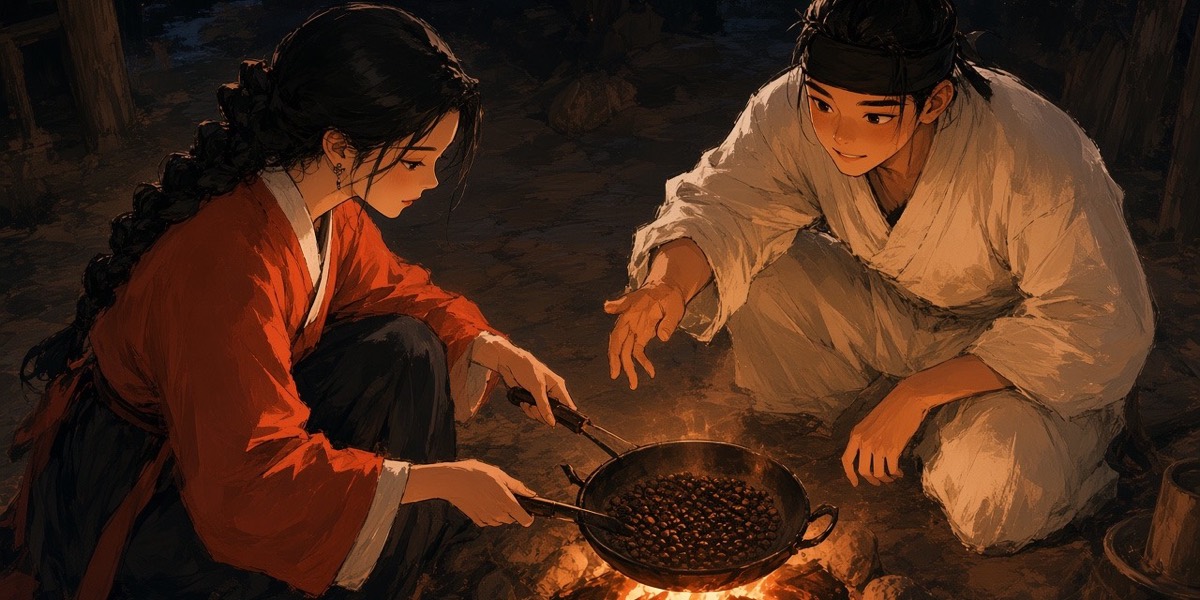
She is roasting beans. He hides the stirring stick. She reaches into the pan with her hand. The beans will burn. They do. On her.
She looks at her hand. Then at him. He does not look away.
She puts the other half of the comb in his hand. Hers is already gone from her hair. Salt in the cakes. Enough salt to make a dog choose water over blood.
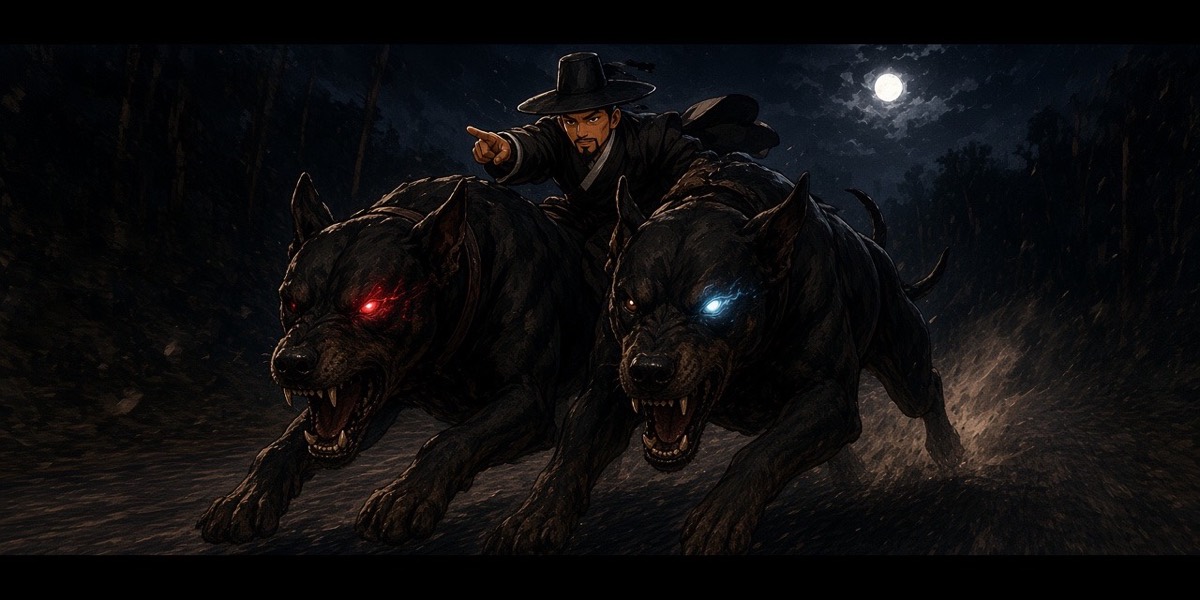
He goes west that night on . The deer does not ask whose house he is fleeing. In the morning finds the boy gone. He does not look for the boy. He looks for the mother.
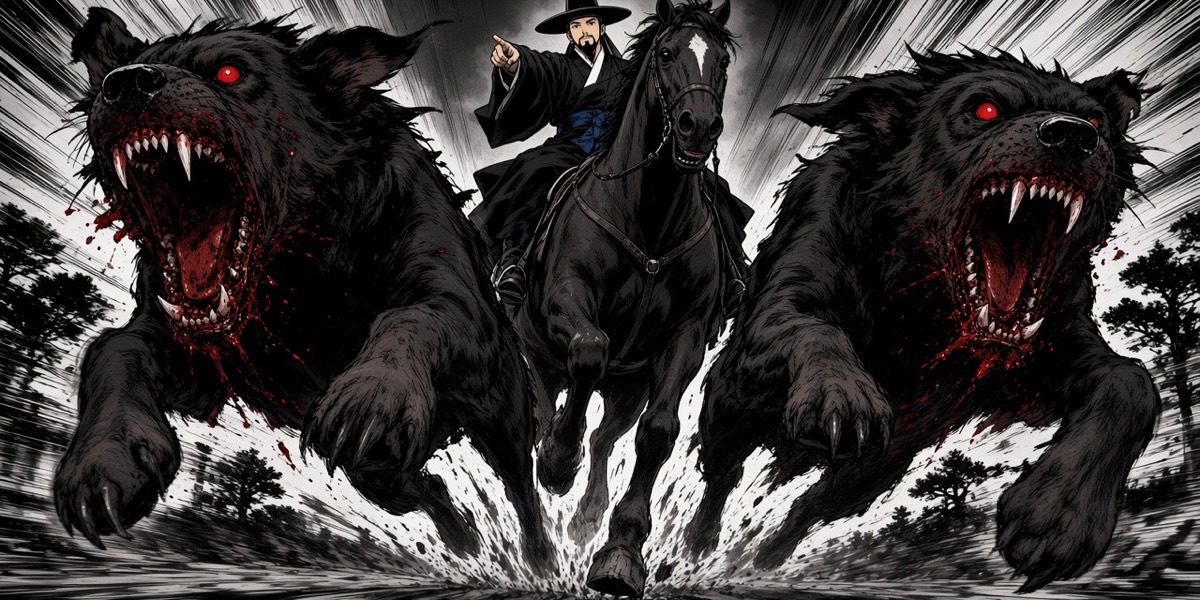
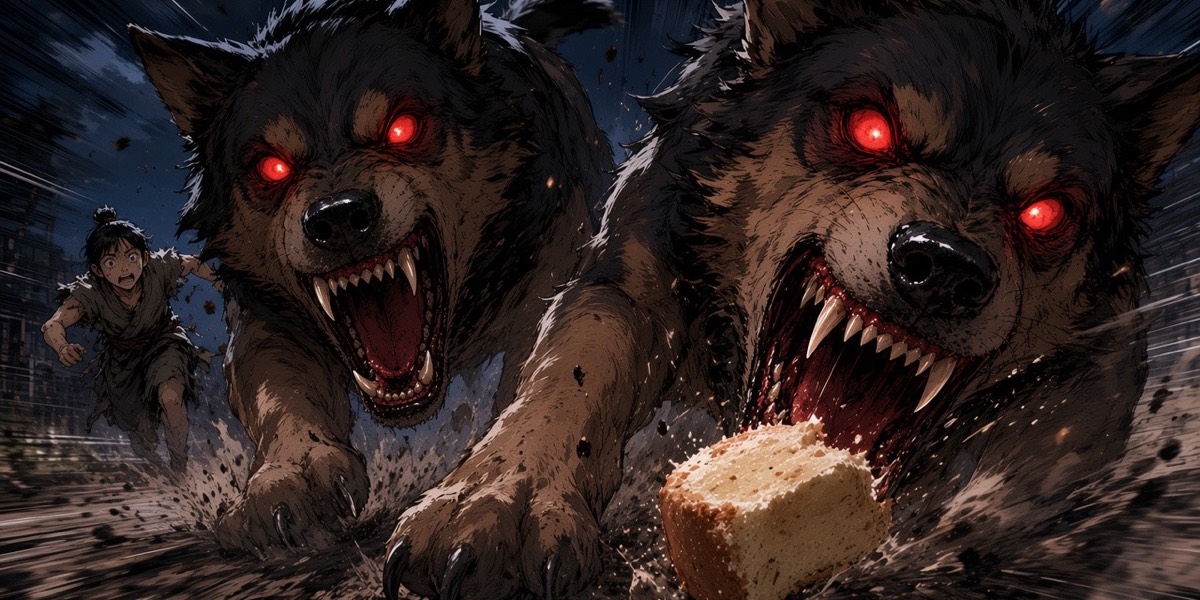
The bloodhounds are older than the roof, as promised. with the red eye. with the blue. One can run a thousand li in a day. The other can run ten thousand. He throws the cakes without looking. He is good at not looking, already. Both dogs take the salt and bolt for water. That is the only kindness left in that house, and it was baked in a hurry.
The magistrate rides behind the dogs. Not shouting. Just pointing. The thousand-year house does not need to raise its voice when it owns the road.
Behind him, already knows. Not the west road — that she will not give. He knows she put the cakes in the boy’s hands. She told him to run. She told him his father’s name. She told him not to come back for her.
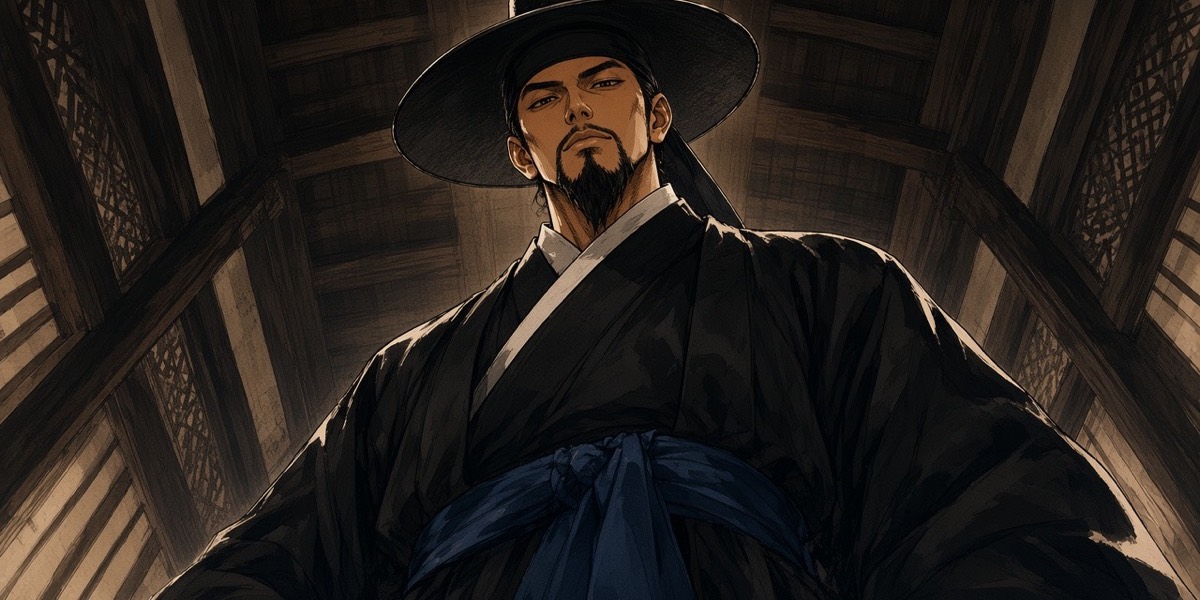
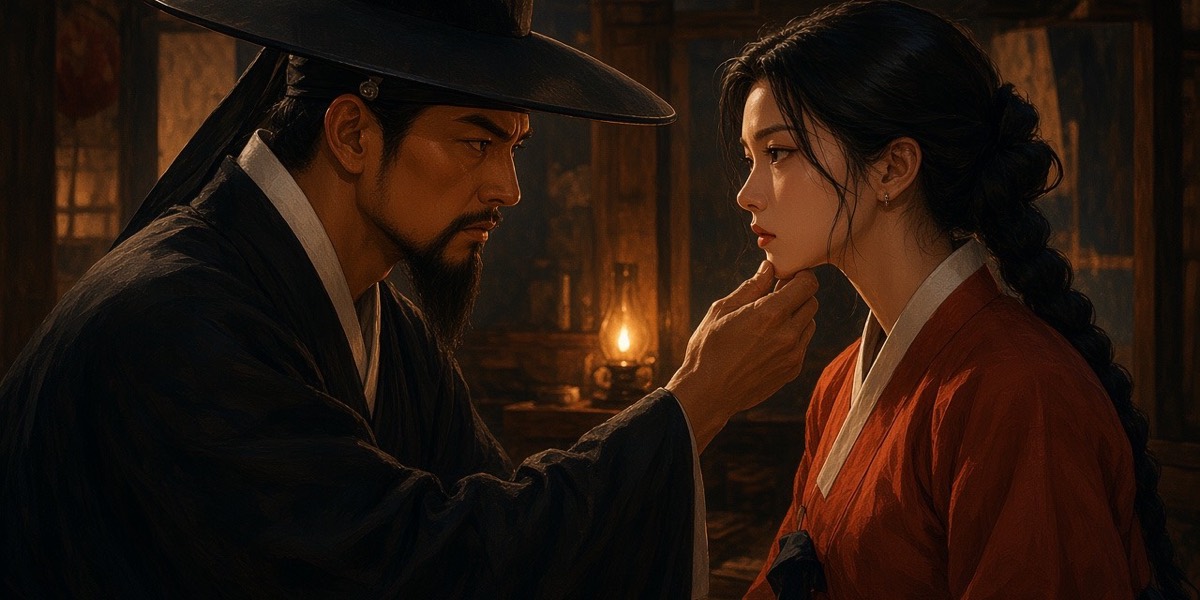
He finds her in the servant room. Vermilion cloth still on. The smile he wears for banquets is gone. Brooding. Dark. The round-top gat throws a hard shadow across half his face.
Before the last anger he lifts her face by the chin. One hand. Soft. He turns her toward the lamp and looks — really looks — at the beauty he waited fifteen years to hear say yes. Vermilion. Braid. The mouth that will not. He almost softens. Then he remembers the cakes. The secret road. The boy gone west to a father.
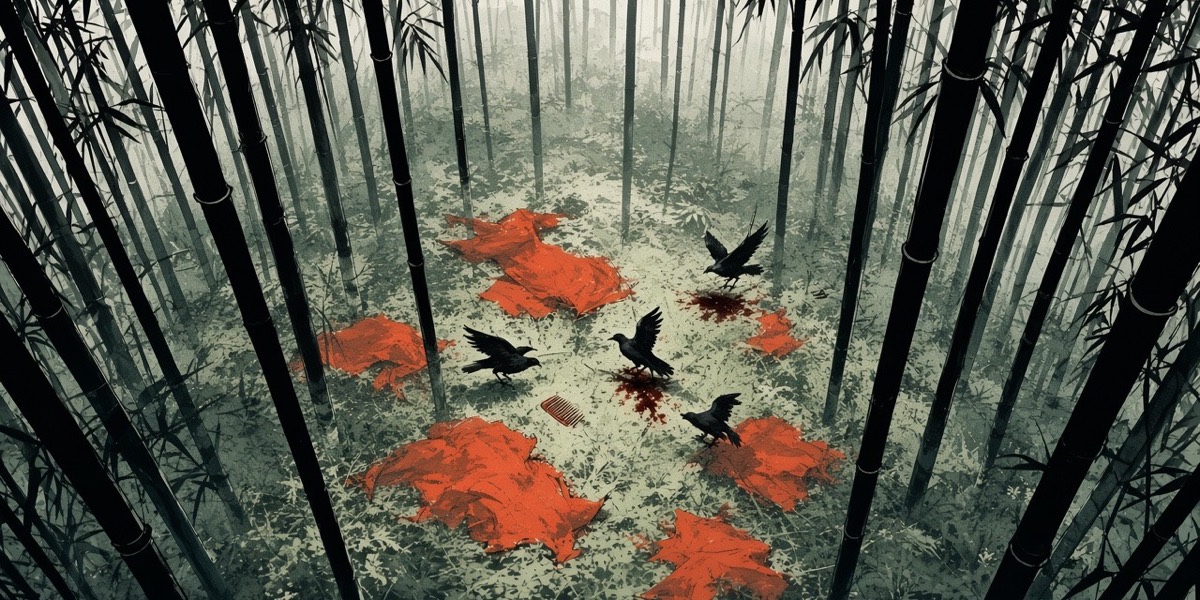
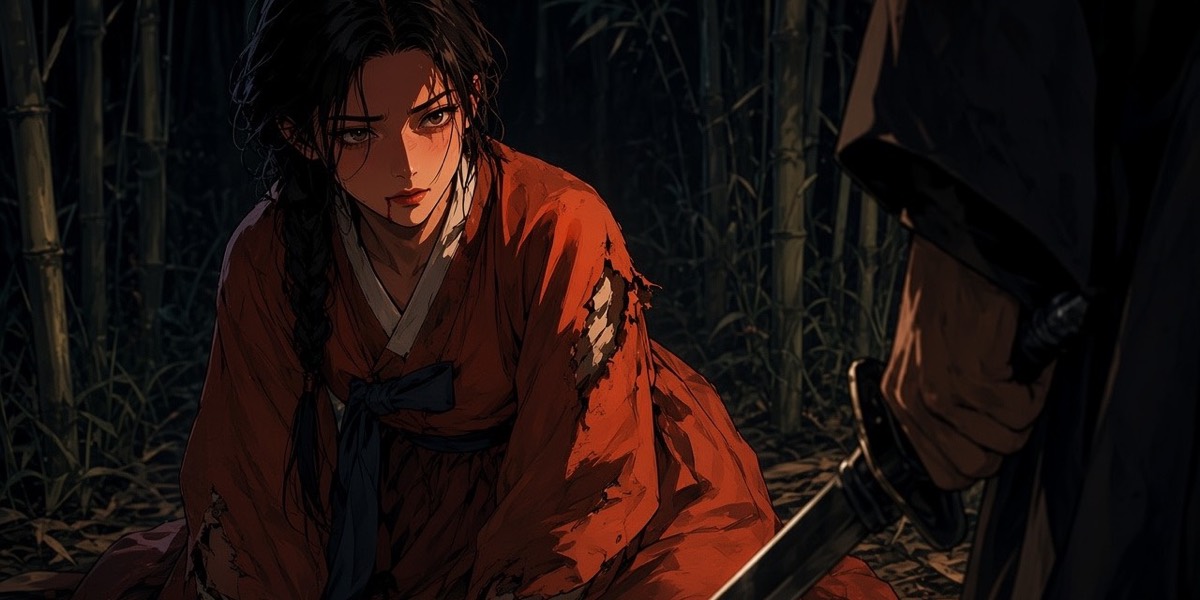
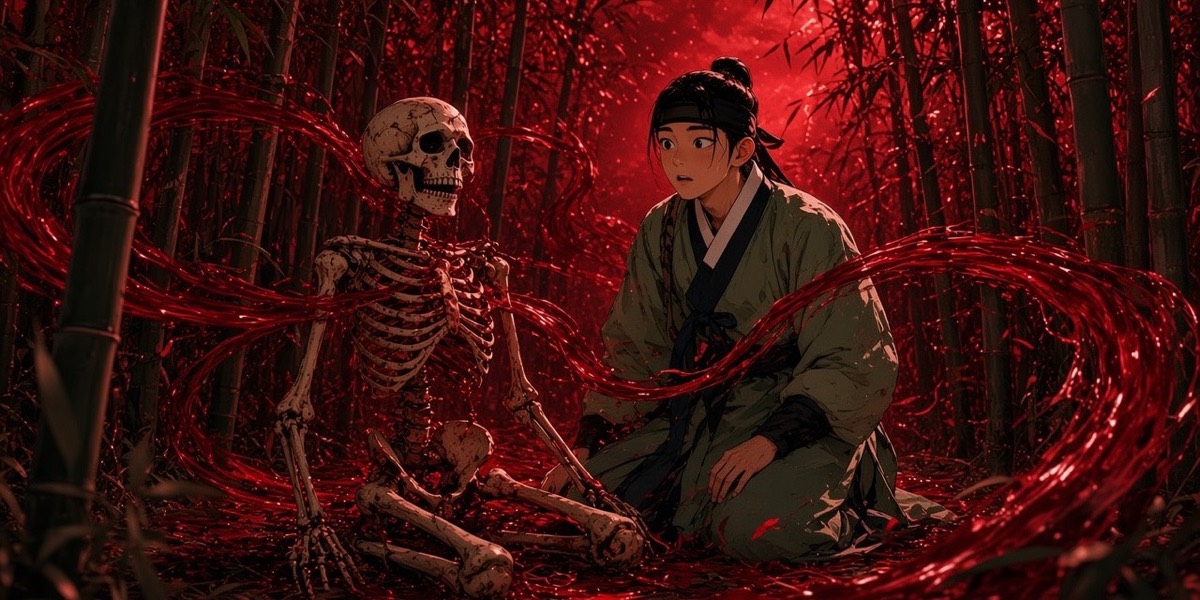
He tortures her three times for the road. She does not give it. Anger does what consent never would — not lust, not patience. On the third time he takes the ring-pommel sword from the yard — the same blade he grunted over every morning, shirtless, trying to burn her out of his body — and cuts her apart: head, arms, legs. He feeds what is left to the crows in a bamboo field.
The west road climbs before it learns how to drown. Twelve mouths. A gate in each. He is on a deer, and fifteen, and alive. The gates were not built for any of that.
stops at the first timber. The boy kicks him through. A gate is not where he is going.
The second mouth is the servant room, still this morning. His mother is at the pan. The stick is where he hid it. She puts her hand in.
She looks at the burn, not at him. The gate opens when he stops the sentence. He did hide it. The road does not want the rest.
Higher up, the one in red is counting bowls that are not there. She sounds pleased.
No stick. No yard. He gets up on the deer as if the dirt were under him. ducks. The mouth is low on purpose.
One gate has nobody in it. Only the soft voice from the thousand-year door.
The boy hides his face in the deer’s neck. That voice is how the house gets a yes. He gives it nothing.
Around the seventh mouth the road tires of rooms. It puts her in the gate and has her say the leaving, and then the coming back, and then the beans. The half comb bites his palm the whole time. He answers none of it. His hands shake on the reins. They shook the same way when he hid the stick.
The last gate is empty. He waits for her to be in it. She does not come. He looks back. Pine. Stone. A wind with no house in it. She told him not to look back.
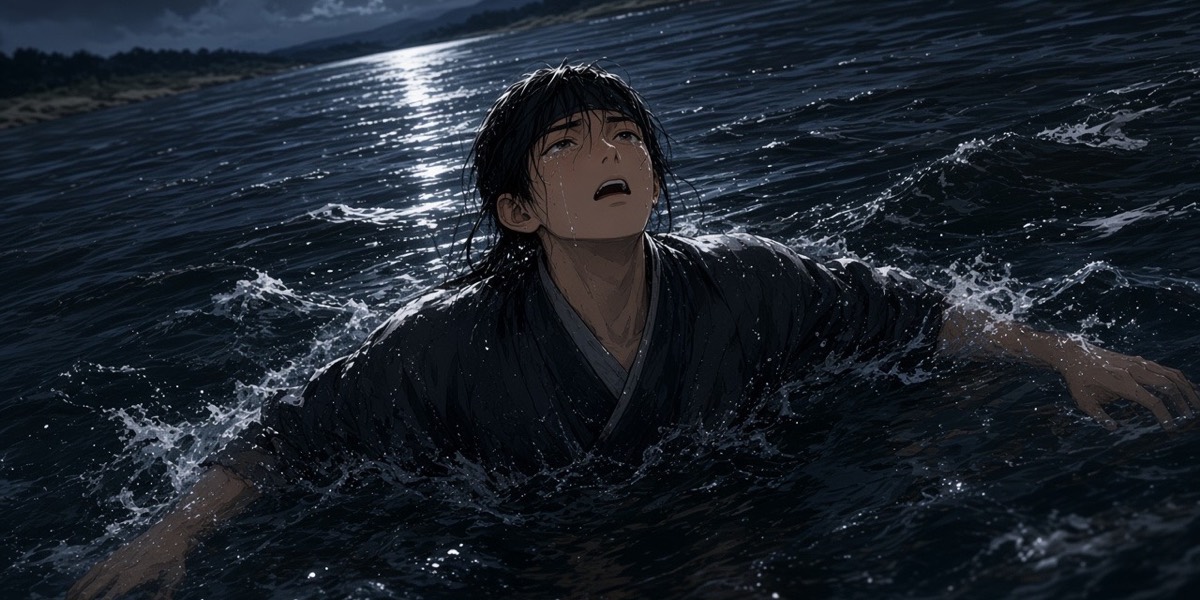
The first water comes to his knees. It is white, and cold, and it knows the burn. Under it, her wrist. He does not take the hand.
He tells the white he is sorry. It rises anyway.
The second water comes to his waist. Yellow. Warmer. It says his name in the voice from before the beans.
He keeps walking, because she said to. His mouth is full of the yellow. He does not spit. Spitting would be an answer.
The third water comes to his neck. Red. He cannot see the deer’s legs. In the red the soft voice is behind him and his mother is under him. He has no air left to tell them apart.
He does not yet know the waters are her tears from the three tortures. He does not yet know what an oath sounds like when it is already spent.
picks the dry ground when there is any. The west road is not a road. It is a refusal that keeps going. He sleeps once against the deer’s neck. He wakes to a sky with no house in it.
He walks until his shadow is longer than he is. fords where a man would drown. At a dry creek bed the ants are waiting again — a thin black line pointing west like a finger. He follows. He eats what the deer finds. He does not turn around when the thousand-year roof falls out of the sky behind him.
Nights on the west road are quiet enough to hear his own blood. He talks to the deer once. The deer does not answer. That is fine. He is learning what his mother meant by keep walking.
Past the third water the living maps quit for real. Flower-smell on a wind that should not have flowers. He follows it because his mother said west, and west is the only word he has left that is not servant.
The living maps run out. Rows of flowers run on anyway, to a gate. A man is standing in it with a basket on his hip, counting. That is what he does when he does not want to think. There is no brightness behind him this time. The light that hired him does not come down for reunions.
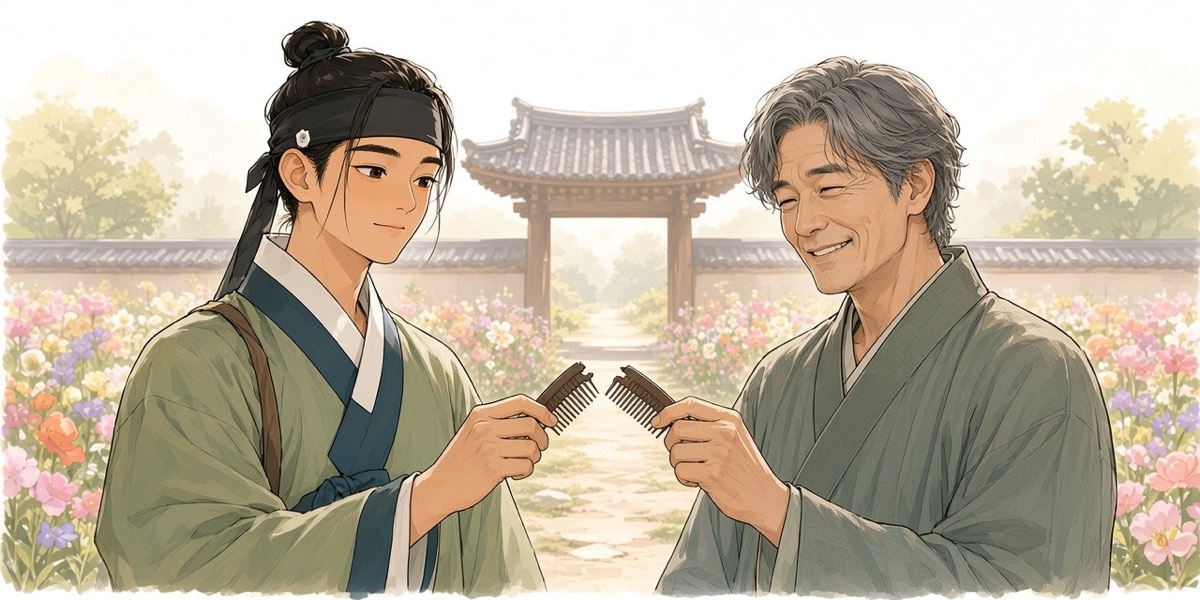
The boy holds up his half of the comb. The man’s sleeve already has the other.
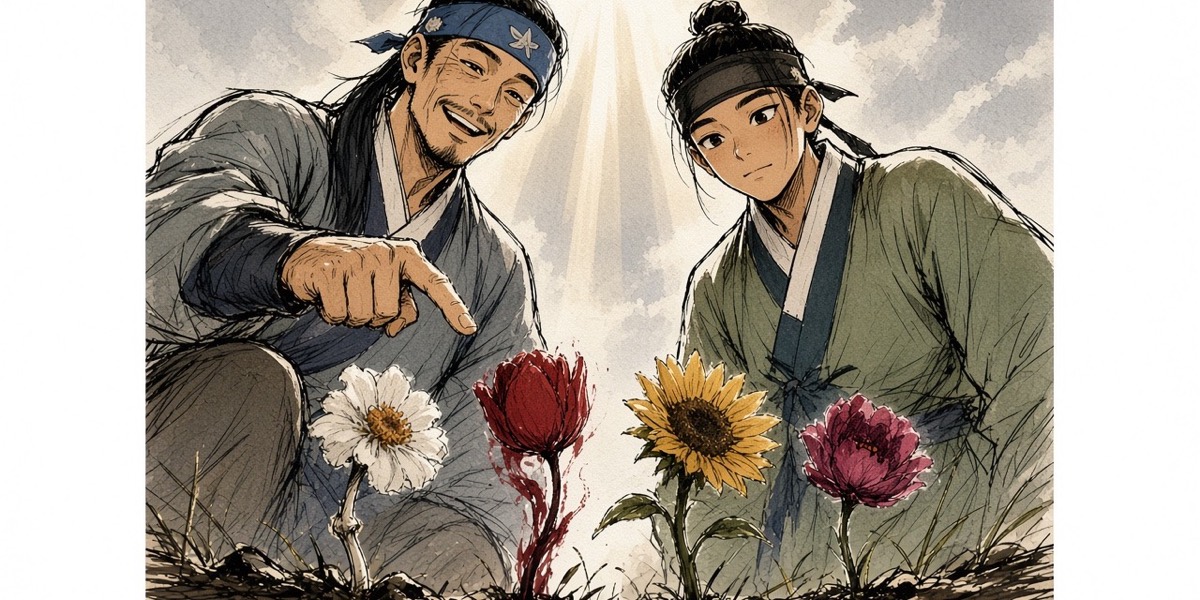
He takes the boy down the rows and names them the way a man names tools.
. . . is the long one, in the middle. . last, or the body wakes with nobody in it.
Across the path, will not stop. picks the fight. keeps a ditch. grew opposite the worst of them. At the end of the row, . That one turns a family on its own meat.
The boy looks at the end of the row. Then he takes from both.
They sit in the rows until the light goes thin. Comb halves on the dirt between them. The first union is not soft. It is two people who share a chin and a debt, learning how to say father and son without choking.
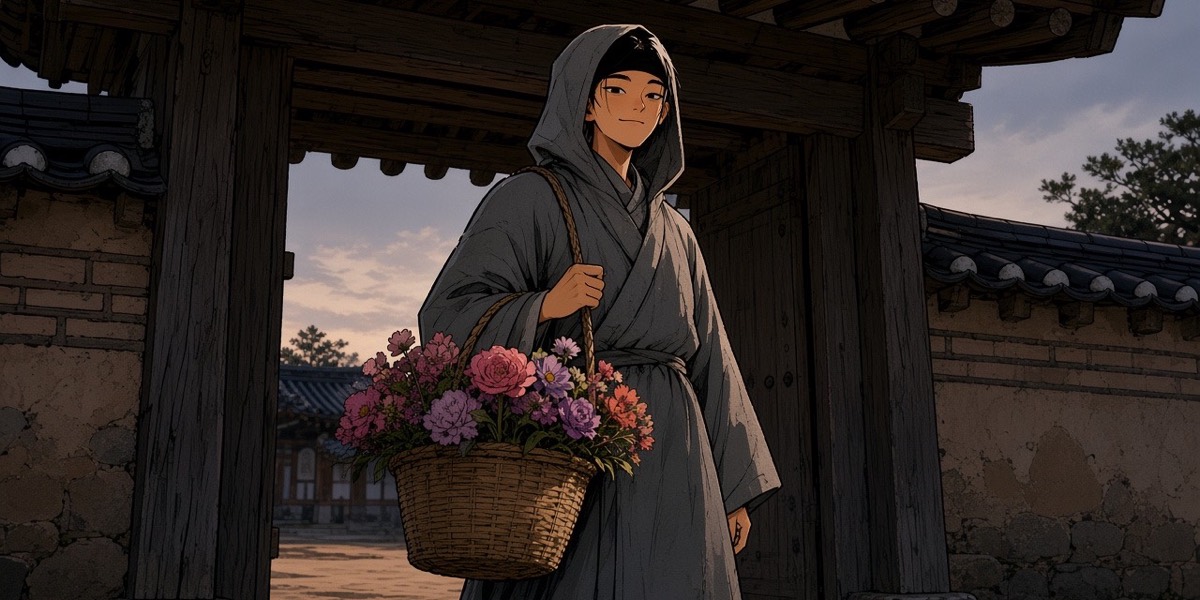
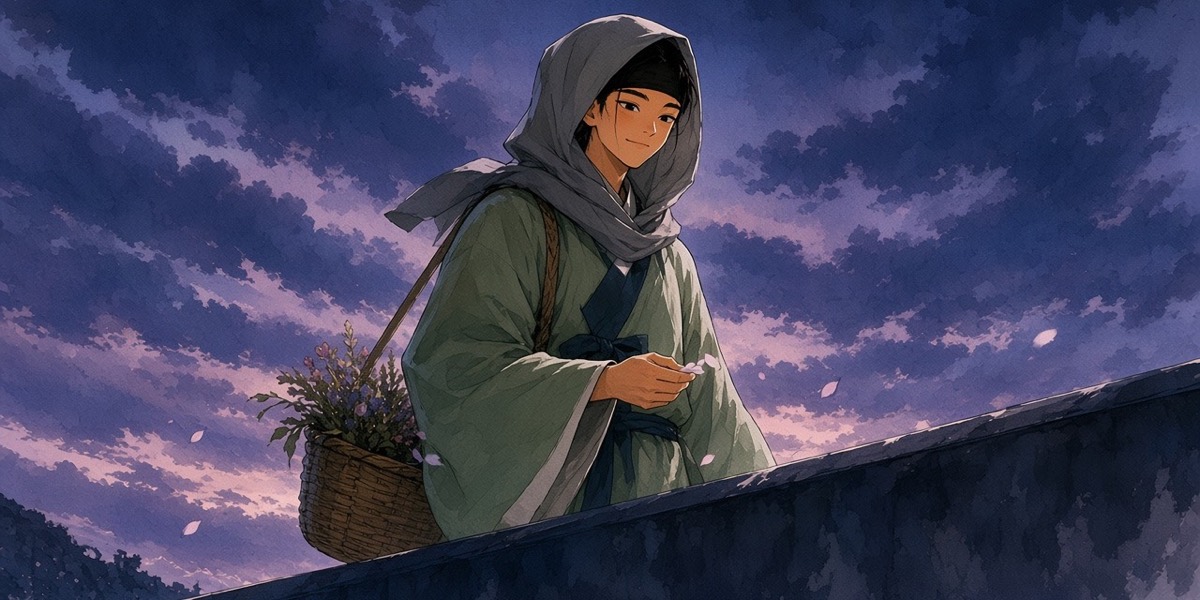
At dusk the boy walks east with a gray hood and a basket on his hip, counting petals the way his father counts seeds. The plan fits in one sentence: we go back with flowers that work.
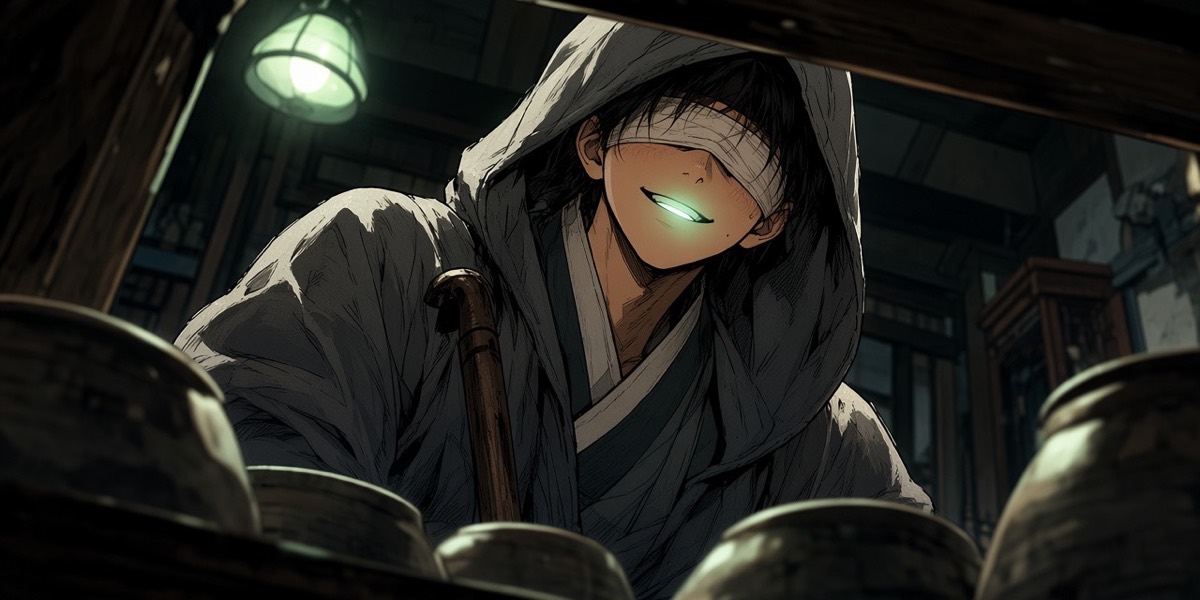
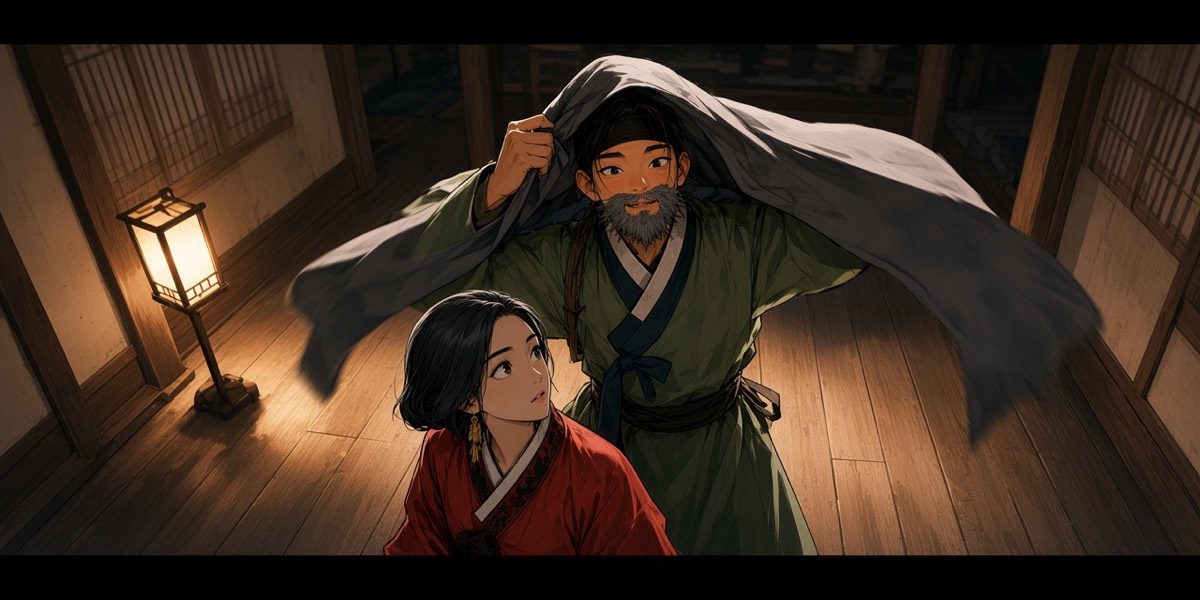
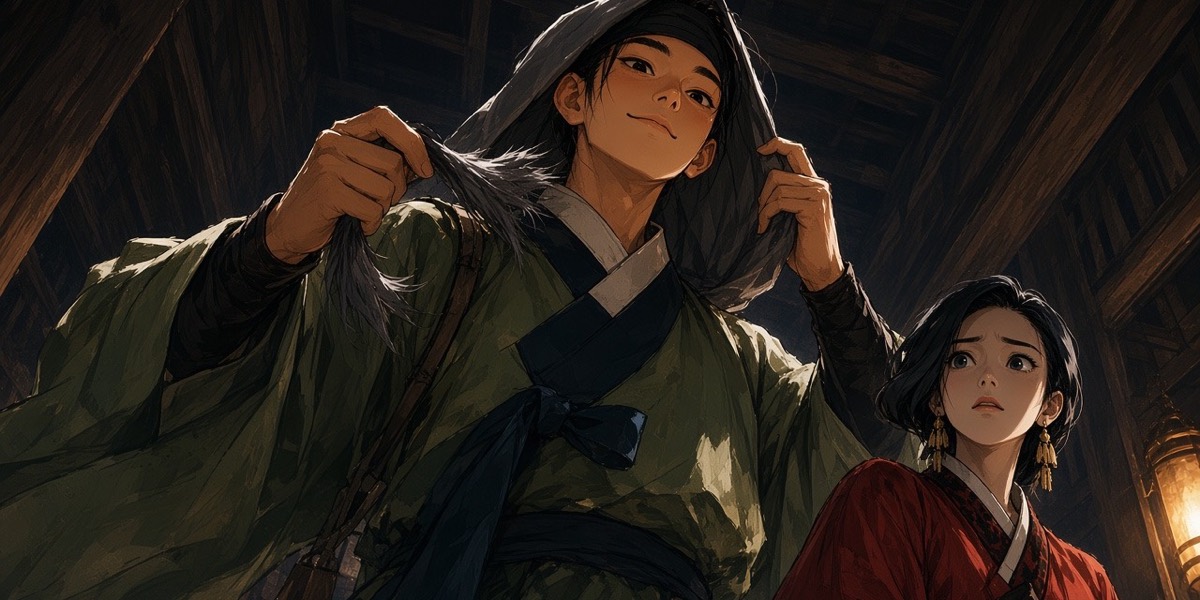
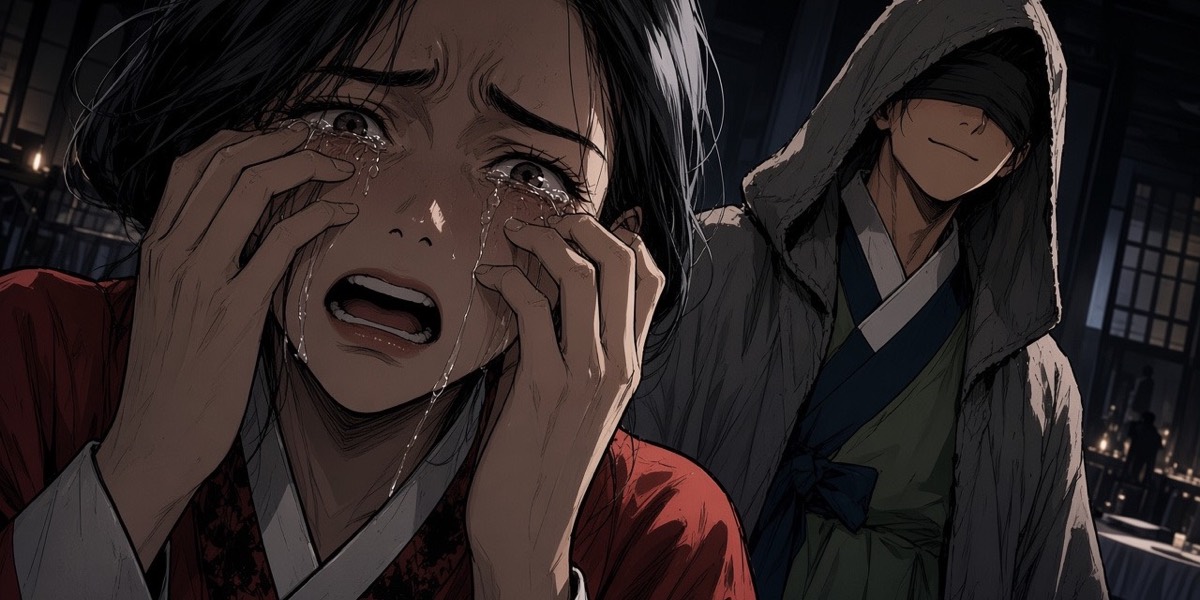
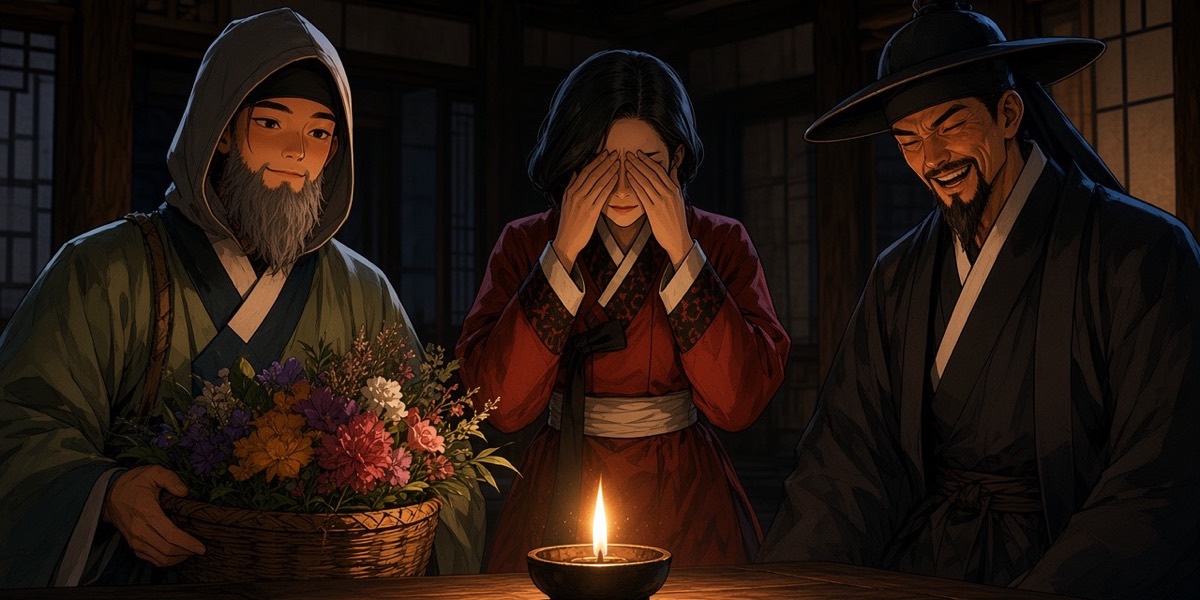
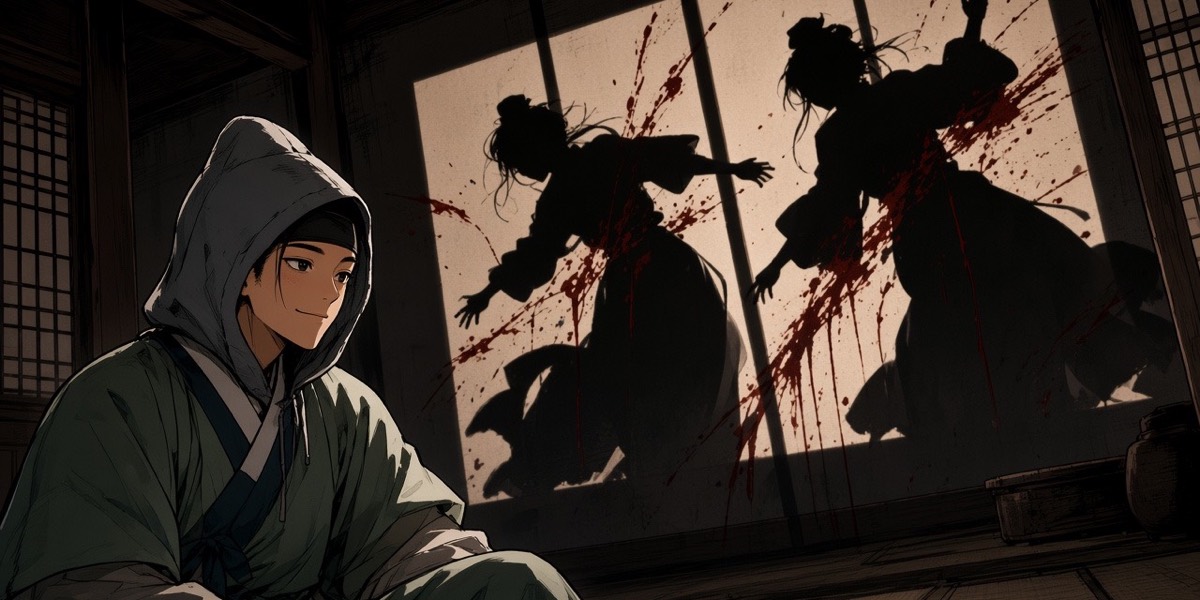
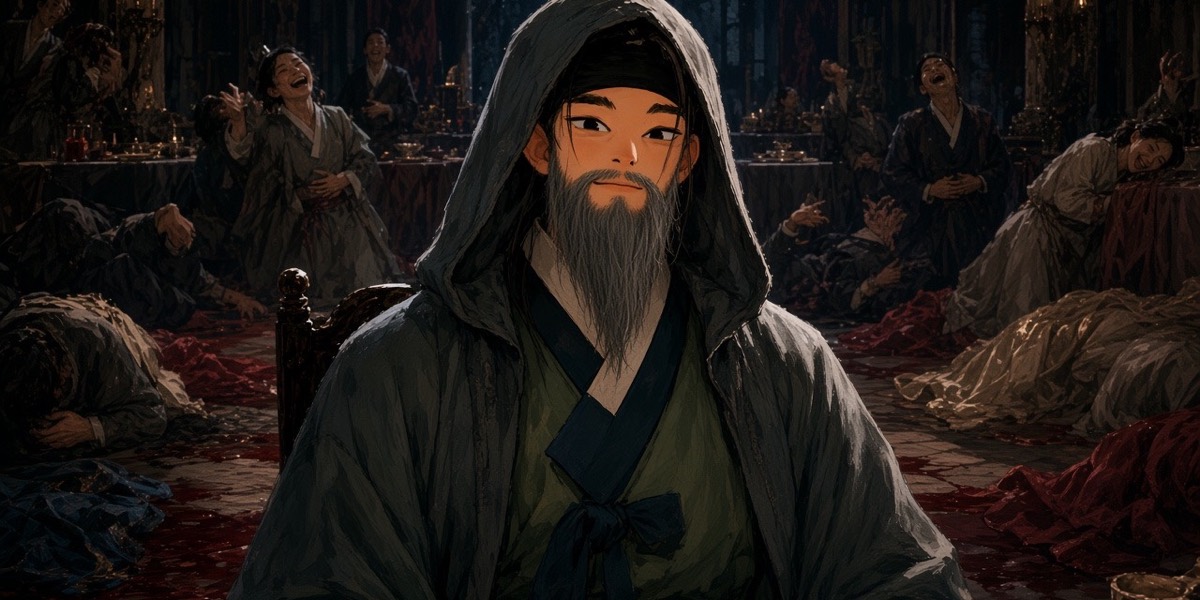
He shows up at ’s house as a blind guest with a basket of flowers on his hip. Gray hood. A fake gray beard glued wrong on purpose — old guest, harmless. The hood never comes off until he wants it to. He is polite about it. He even smiles, a little, for the first time you will recognize.
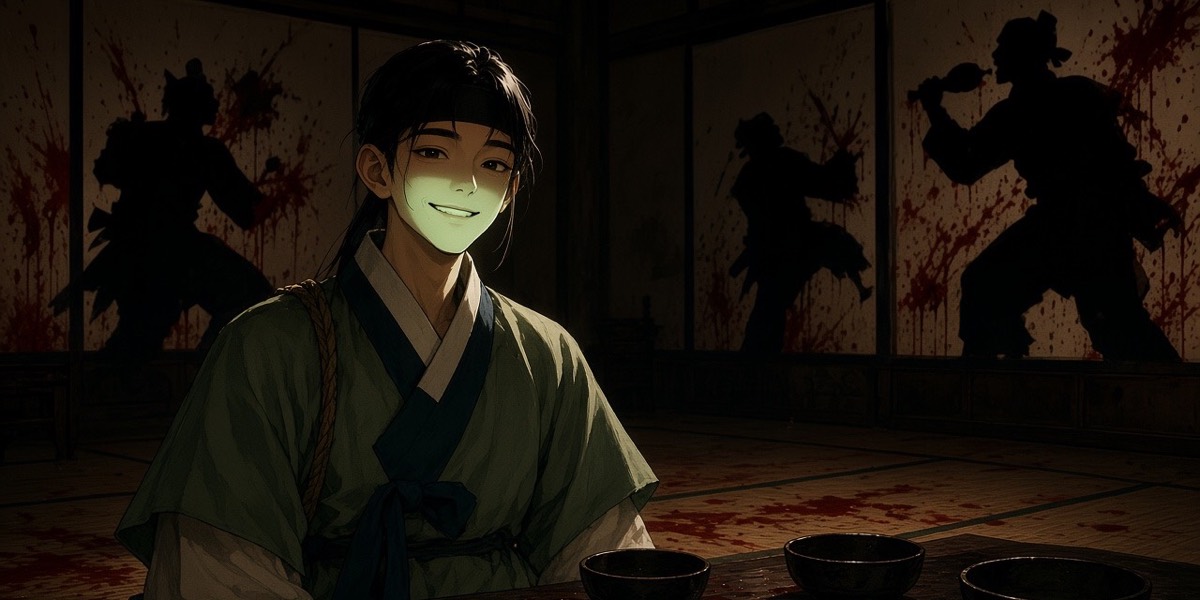
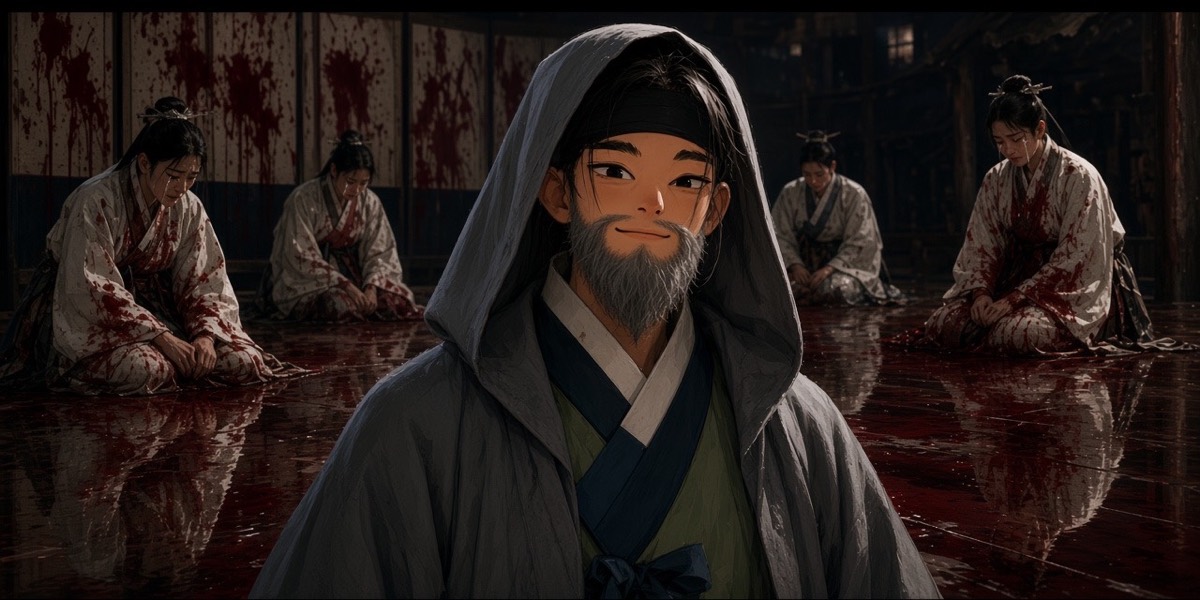
first. He sits at the head of the table with a guest’s smile under the fake gray beard — soft, almost kind — and watches. The household cannot stop. They laugh until they cannot stand. Then they laugh on the floor. Blood comes with some of the laughs. Under the hood his smile stays gentle.
next. They cry for nothing — for the mother they threw to crows, for the boy they worked until his hands stopped looking like hands — until the hall is slick with it. He does not look away. Gray beard. Gentle smile. Blood on the screens.
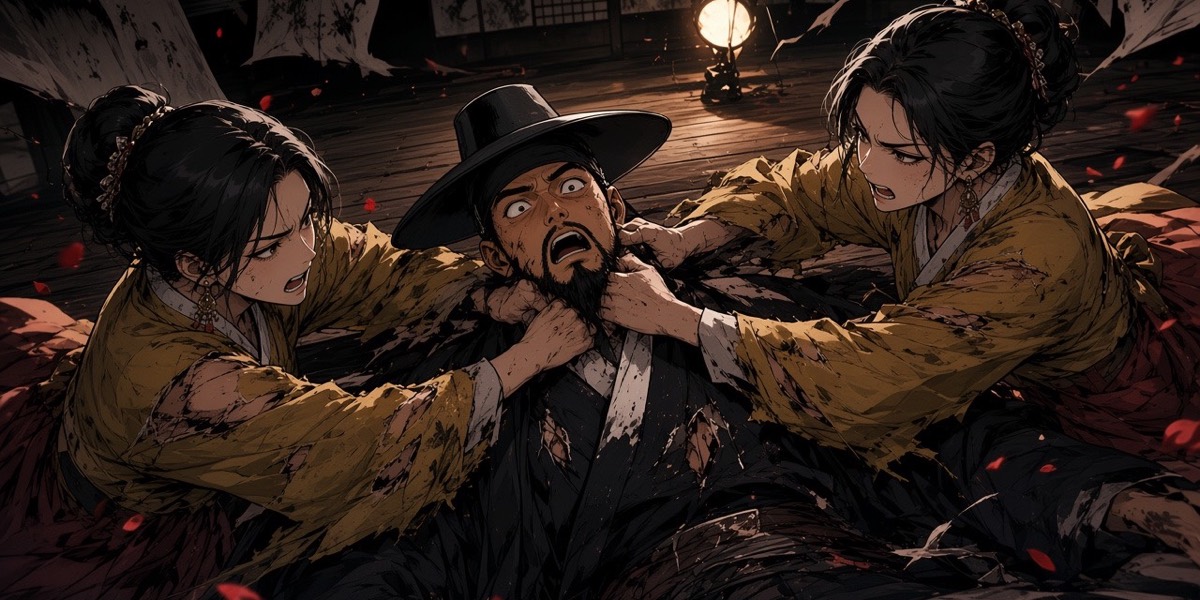
Only after the house has laughed itself raw and cried itself empty does he bring out . The one from the end of the row. He tells to cover her eyes. She does. On the far screens dies the way a hunted animal dies — mauled by his own daughters driven mad by the heart-flower, silk and blood and the sound of a house eating its master. Under the gray hood and the fake beard does not look away. He is still gently smiling.
He keeps . He needs a witness, not another flower. She peels her hands from her eyes and the hall is already quiet. The first and second are already gone into that quiet. Her hands shake so hard the silk at her wrists makes a sound. Under the gray hood the blind guest waits for her to speak.
He tips the gray hood back. Blind cloth gone. Fake gray beard peeled with it. The same worm’s-eye used on the world — now the boy owns it. Young face. Gentle smile. He looks down at shaking in the corner, and the pose is the echo: chin high, soft mouth, eyes that do not blink.
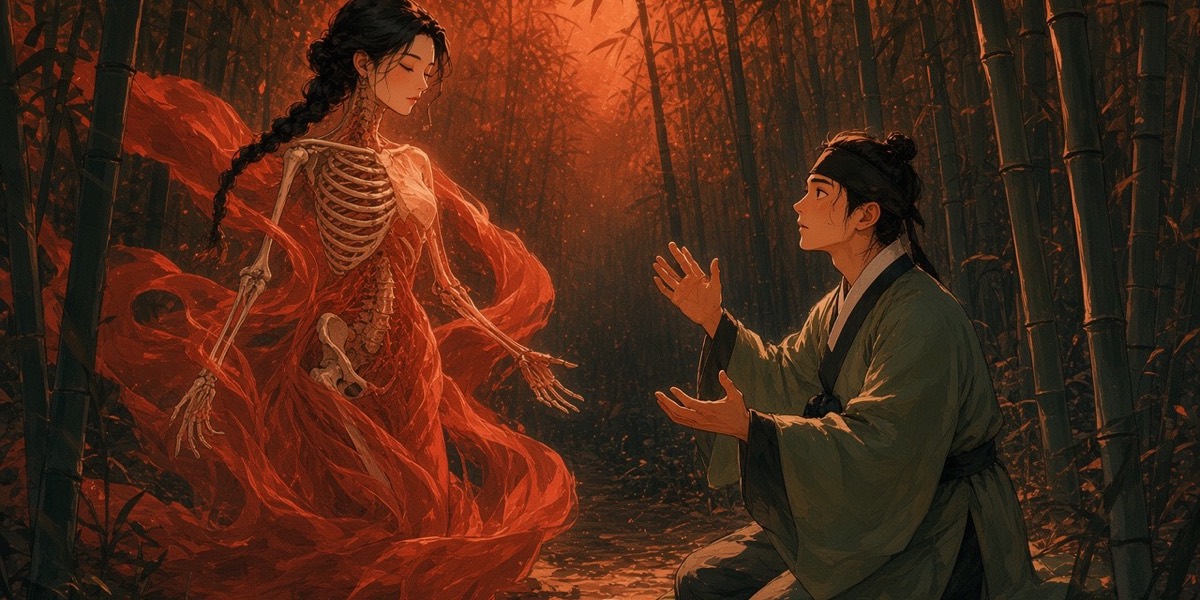
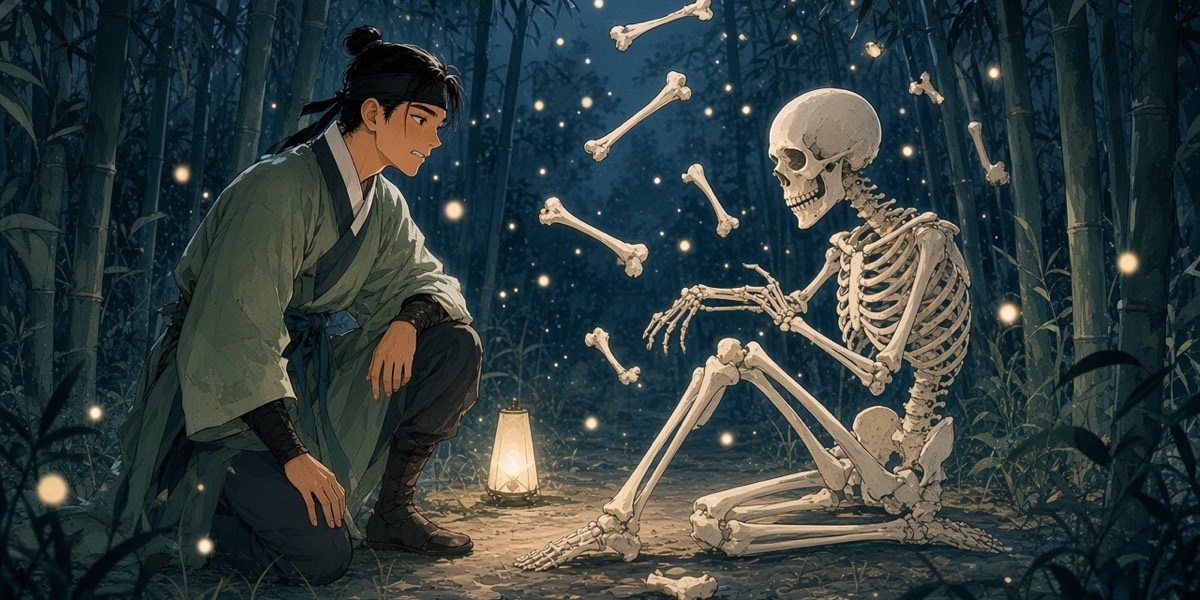
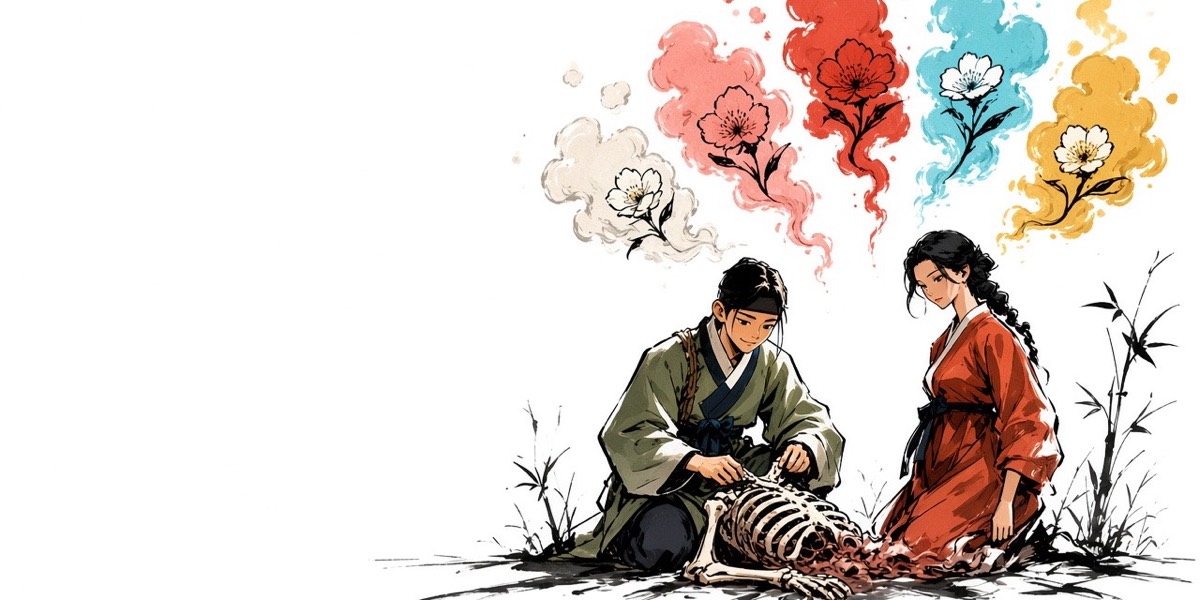
He finds what the crows left in the grove and puts her back together in order. Not all at once. hates a rush.
first. White order in the bamboo dark. A skeleton that knows how to sit up when a son asks it to.
next. Vermilion cloth remembers her. The winter rose is not in yet. She is almost a person again.
. It finds the joints the way a river finds a dry bed. Red returns before the face does.
. The long name, and the long wait. The organs remember where they sat.
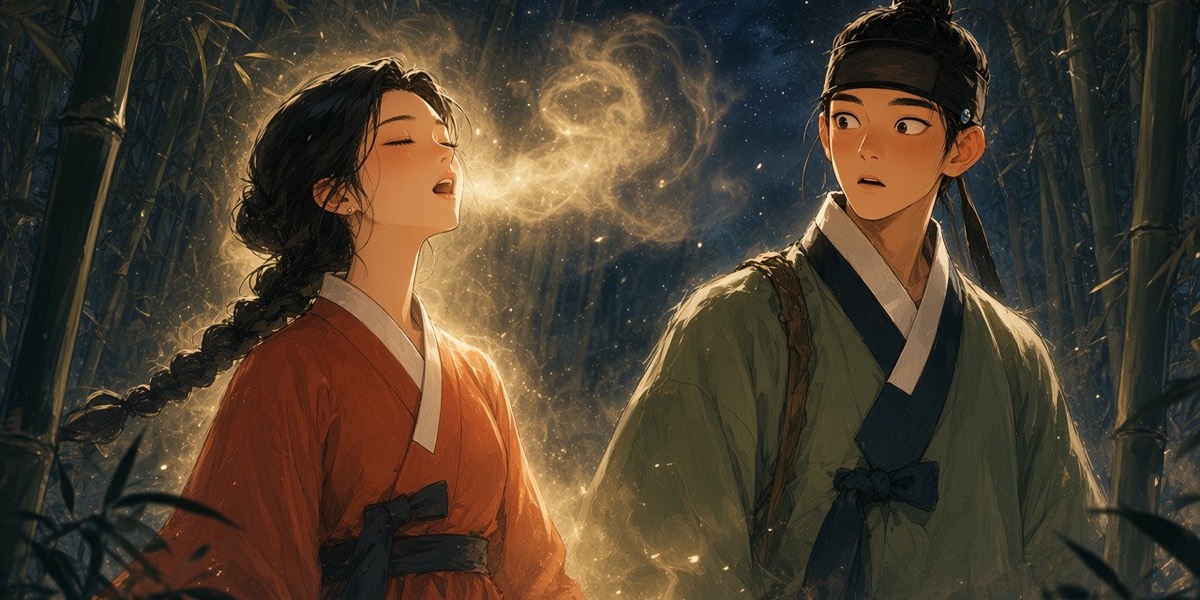
. One pull of air that hurts to watch. Bamboo leaves move. She is not a picture anymore.
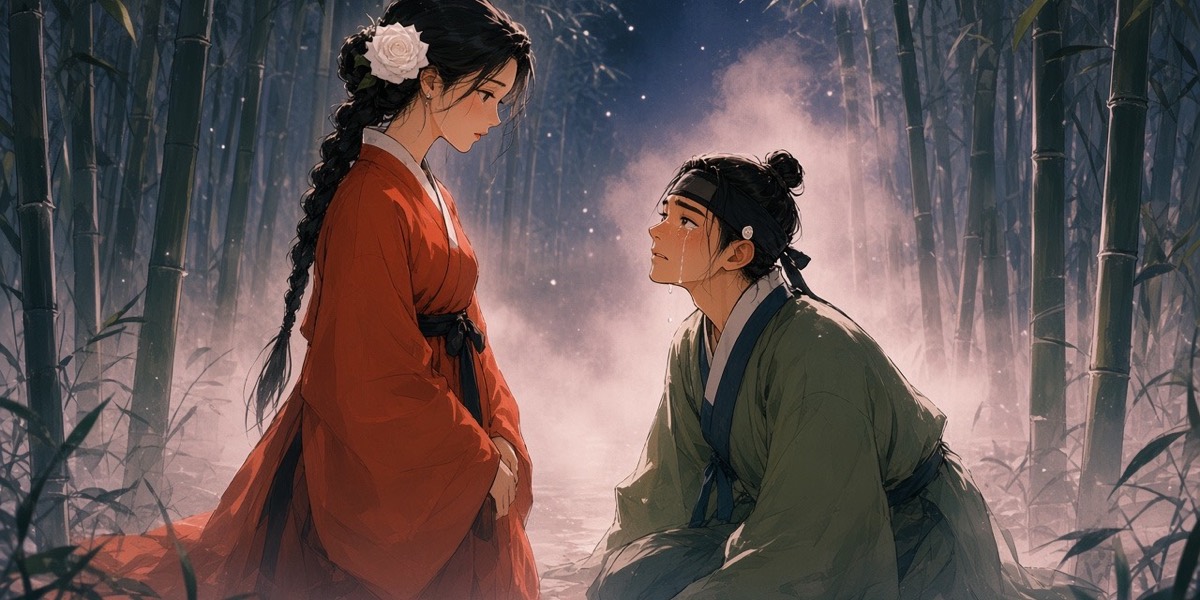
comes last of all, because that is the one that hurts if you rush it. The winter rose opens in her hair. Her eyes find him.
She stands. Winter rose still white in her hair. She walks to the gate herself.
Saradoryeong is counting seeds at the western gate because that is what he does when he cannot look at what he left. The basket shakes. The seeds do not help.
He sees her and the basket drops. Fifteen years come out of him in one sound. Not a god’s sound. A husband’s.
He falls to his knees in the flower dust. He crawls the last step. He takes her hands and presses his forehead to them and does not stop shaking. The boy watches from the rows and does not interrupt. This is not his scene.
He cries anyway. Hard. The way a man cries when the thing he abandoned walks back wearing a winter rose and still knows his name.
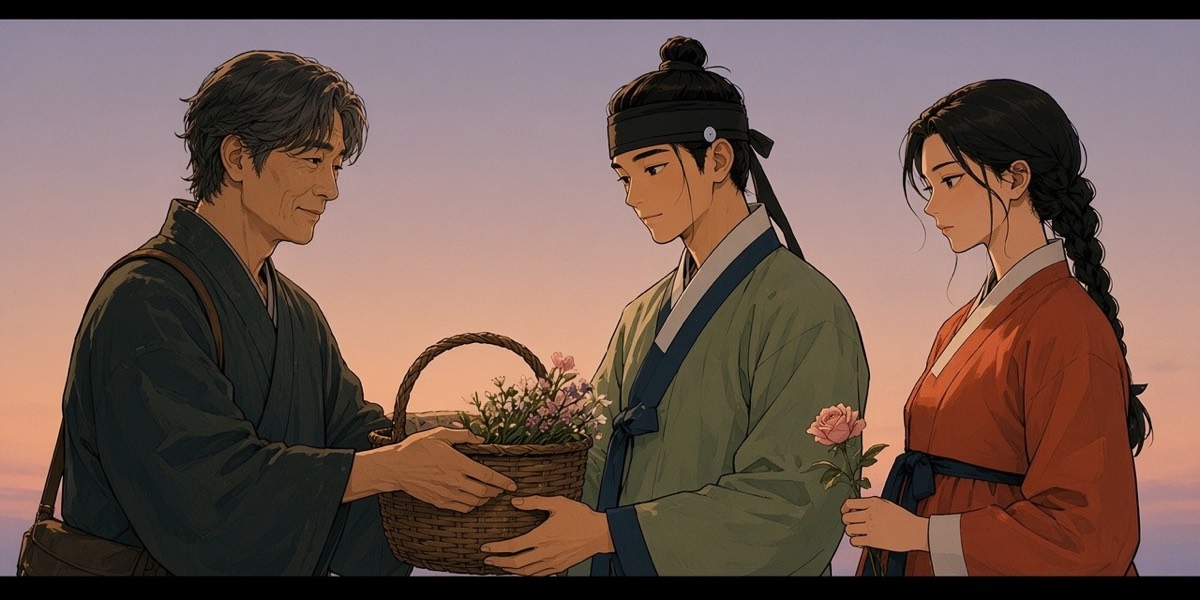
He puts the basket in his son’s hands. The weight is ordinary. That is the point. Father retires the way retires — chair emptied on purpose — and takes his arm as if fifteen years were a door they can finally close from the outside.
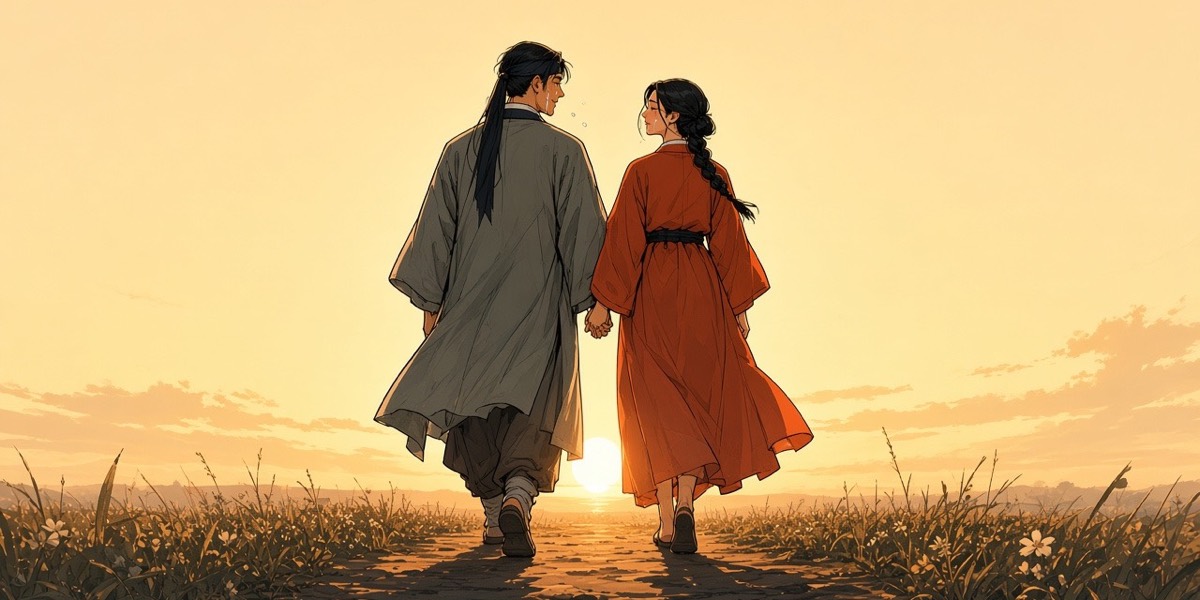
They walk west of the rows into a light that is finally allowed to look like a sun. No brightness without a face. No voice from above the roof. Just two small figures on a ridge, and a long gold hour, and the boy behind them already counting — because that is what he does when he does not want to think about who left.
The smile stays. That is the part people like. They do not ask what he had to pick to learn it. They do not ask what a childhood tastes like, when the house that raised you ends as a meal.
Millet goes in at the start of summer. The soil here is so light the wind lifts the seed straight back out. So once it is sown, the village drives horses over the field, back and forth, until the ground is packed.
is given the horses. He is as good with horses as he is bad with people.
He turns the horses at the wall and brings them back down the field.
Neither of them says anything for the whole length of the field. The horses do not care. They reach the wall and turn.
The island keeps one story for last. It is about the one who comes for you, and the crow that lost his book…!
